
Video streaming is the continuous transmission of video data over the internet, played as it arrives rather than downloaded in full first. That’s what lets a video start playing within seconds instead of waiting minutes for an entire file to save to your device.
This guide covers how streaming actually works under the hood, how it differs from downloading, the two main types of streaming, and the technical pieces that combine to make it all work.
How Does Video Streaming Actually Work?
Video streaming works by breaking a video into small pieces, sending them continuously, and playing each piece as it arrives — with just enough of a buffer stored ahead of playback to absorb small network hiccups without the video stopping. Nothing about that process requires the full file to exist on your device at once.
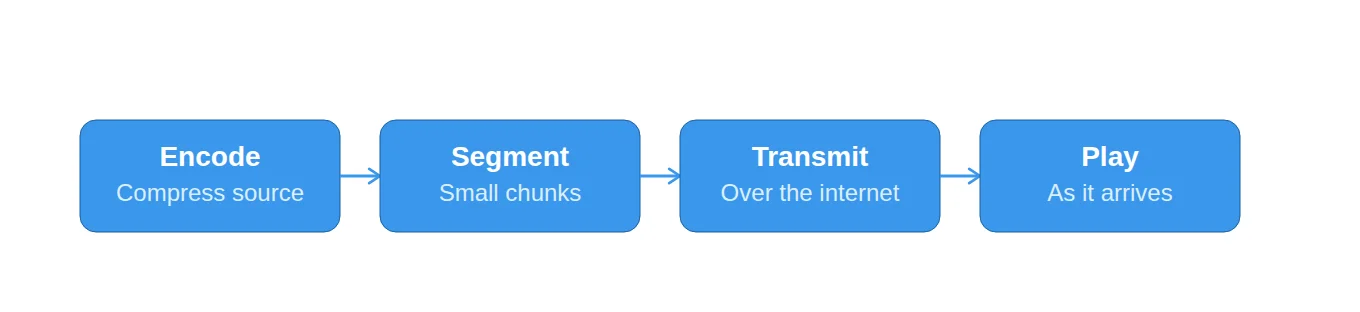
The core pipeline:
- Encode — The source video is compressed into a format small enough to transmit efficiently.
- Segment — It’s broken into short chunks, the same approach we cover in What Is M3U8?
- Transmit — Those chunks travel over the internet, typically through a CDN for speed and reliability.
- Play — The player buffers a small amount ahead of the current position and plays each chunk as it’s received.
Streaming vs. Downloading — What’s the Difference?
The core difference is when playback can start: downloading requires the whole file to save to your device before you can watch it, while streaming plays content as it arrives, discarding most of it after playback rather than keeping a permanent local copy. That’s why streaming lets you jump into a two-hour video almost instantly, while downloading the same file might take several minutes before you can press play.
Live Streaming vs. On-Demand Streaming
Streaming splits into two fundamentally different types based on timing. Live streaming transmits video in real time as it’s captured — a live event, webinar, or broadcast — with only a few seconds of delay between what’s happening and what viewers see. On-demand streaming (VOD) delivers pre-recorded content that’s already fully encoded and stored, ready to stream anytime a viewer requests it. The underlying streaming mechanics are similar for both; the difference is whether the content exists yet before someone hits play.
Why Has Video Streaming Taken Over?
Streaming isn’t just common now — as of 2025, it became the dominant way people watch television, period. According to Nielsen’s official measurement, streaming’s share of total U.S. television viewing reached 44.8% in May 2025, surpassing broadcast and cable combined (44.2%) for the first time since Nielsen began tracking the category. By December 2025, that share had grown further to 47.5%. What used to be an alternative to television has become the default.
The Building Blocks Behind Every Stream
A working video stream is really several separate technologies stacked together, each solving a different problem — which is why “streaming” ends up meaning different things depending on which layer someone’s talking about.
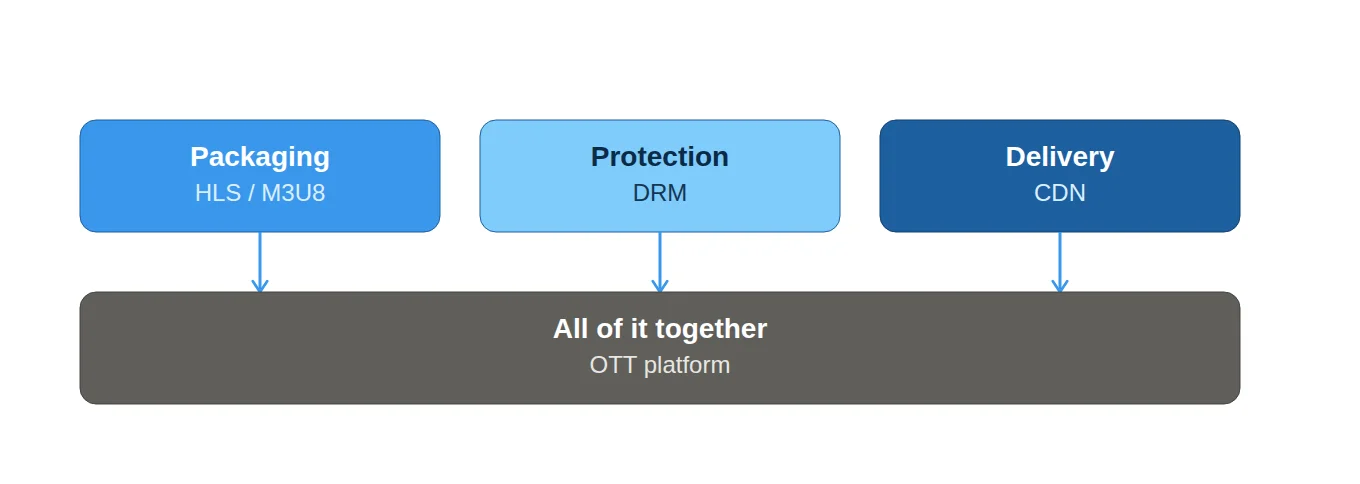
- Packaging — Organizing the encoded video into an adaptive format like HLS, using M3U8 playlists to let quality adjust to the viewer’s connection.
- Protection — Controlling who can decrypt and play the stream, covered in What Is DRM?
- Delivery — Distributing that stream globally through a CDN so it plays smoothly regardless of where the viewer is.
Put all three together with a business model on top — subscriptions, ads, or pay-per-view — and you get what’s generally called an OTT platform, which we cover in more depth separately.
Common Types of Video Streaming Platforms
- Consumer entertainment — Netflix, Disney+, and similar services, running on the SVOD model.
- Course and coaching platforms — On-demand video libraries gated behind course access or membership.
- Business and enterprise video — Internal training, sales, and marketing content, covered in our business video hosting guide.
- Live events — Webinars, conferences, and broadcasts streamed in real time.