
Inkrypt beats standard video encryption platforms by combining studio-grade DRM, dynamic AES-128 key protection, IP/geo-restriction, domain whitelisting, and RTMPS delivery in one system — instead of forcing you to stitch these layers together yourself, or relying on the single-layer encryption most basic platforms still use.
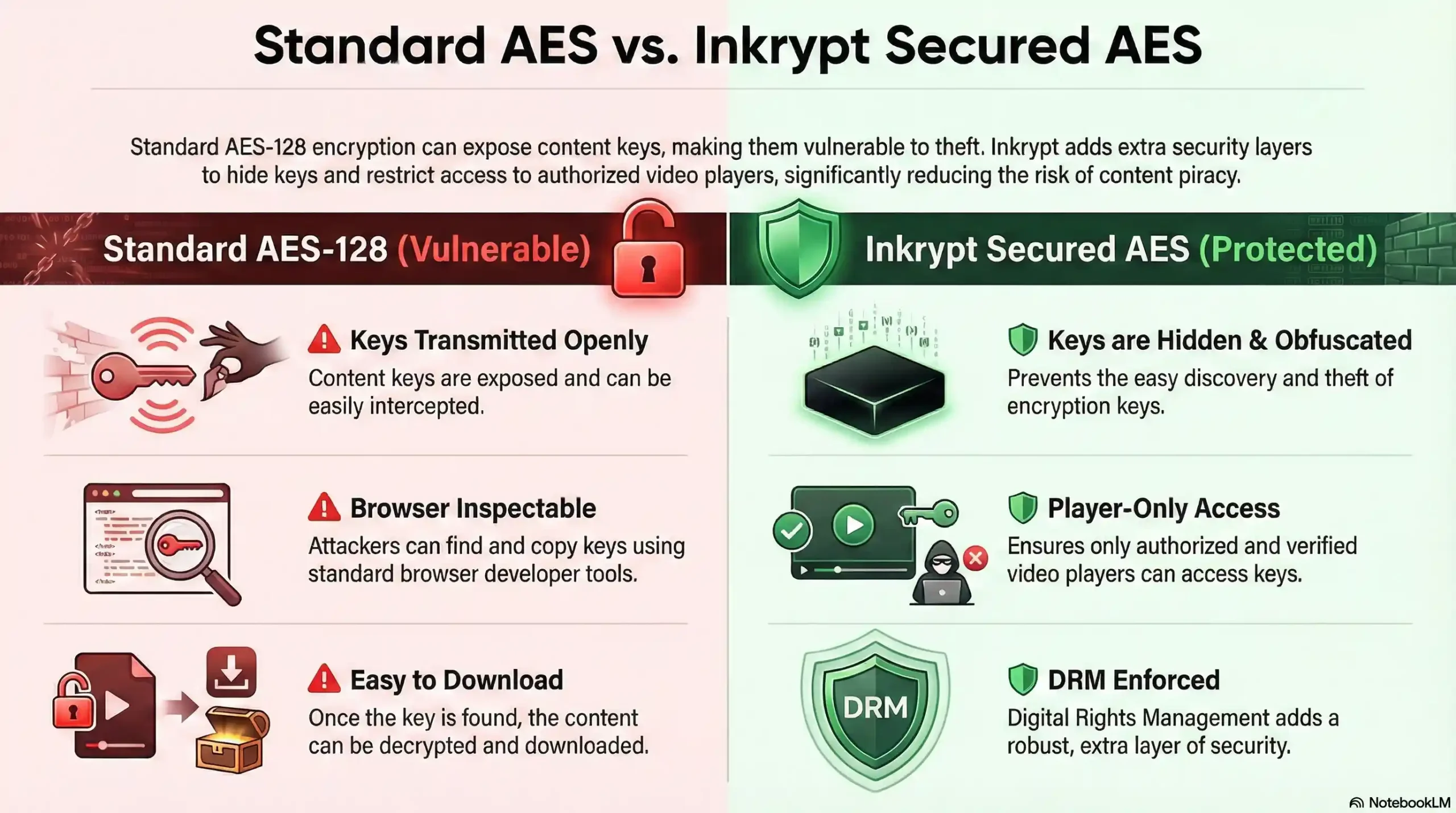
Standard encryption is no longer enough to stop premium video piracy; if the decryption keys are exposed, your content is vulnerable. Inkrypt Security outperforms traditional methods by combining advanced DRM protection with dynamic AES-128 encryption and strict domain whitelisting. This multi-layered approach ensures that only authorized users on approved devices can decrypt and view your revenue-generating content.
Secure Your Premium Video Content Now
DRM Encryption for Password Protection
DRM-backed protection goes further than a shared password: it issues a unique license to each authorized viewer’s device, so the video itself can’t be replayed, downloaded, or shared outside Inkrypt’s player — even by someone with valid login credentials.
Inkrypt protects your videos with a powerful password-protection layer reinforced by DRM. Unlike a standalone password wall — which only checks a viewer’s credentials once at login and then hands over an unprotected file — DRM ties each viewing session to a license issued for that specific user and device. That license controls whether the video can play, and for how long, without ever exposing a downloadable file. So even a fully authorized, logged-in user can’t extract the video, share the direct file link, or replay it outside the app or website it was licensed for. This closes the most common leak point in basic password-protected video: a valid user forwarding the file itself rather than the login.
Secure Decryption With AES-128 Encryption
Basic AES-128 implementations often expose the same content key to anyone who inspects the player, letting that single key decrypt every copy of the file. Inkrypt keeps content keys hidden from the player entirely, releasing them only to verified, authorized players at the moment of playback.
As content keys are easily accessible in many basic AES-128 implementations — often embedded in the player’s manifest file or client-side code — a single leaked key can decrypt every video protected with it, not just one. Inkrypt keeps content keys hidden from the player and the end user entirely. Keys are held server-side and released only to authorized, verified video players through a license request rather than a static file. So even if someone captures network traffic or inspects the player, they don’t get a reusable key — only a session-specific license tied to that one playback.
IP Access & Geo Restriction
IP and geo-restriction control where a video can be watched from, independent of who’s logged in — useful when you’re licensed to distribute content in only some regions, or want to block access from outside a corporate network.
Inkrypt utilizes IP control and geo-restriction algorithms to ensure that only allow-listed IP ranges and IP addresses can access your videos. You set the countries or regions where viewing is permitted, and any request from outside that zone is blocked before the player even loads — regardless of whether the viewer has valid login credentials. This matters most for regionally licensed content and for internal training content you want restricted to your office network’s IP range.
Domain Whitelisting for Complete Security
Domain whitelisting locks video playback to the specific website or app domains you approve — so even if someone copies your embed code, the video won’t play anywhere else.
If you create premium video content, such as training videos for your employees, it’s important to ensure only your employees have access. Domain whitelisting is the key to that. Add the domains where your video is legitimately embedded, and Inkrypt blocks playback from any domain outside that list — a common way embed codes get quietly re-used on scraper or mirror sites.
More Security Than RTMP Encryption
RTMP transports raw video, which makes intercepted streams straightforward to capture and replay. RTMPS wraps that same transport in TLS encryption, so intercepted traffic is unreadable without the session’s keys.
Inkrypt helps protect premium videos with RTMPS encryption rather than standard RTMP. It’s more secure because RTMPS transports encrypted commands and data rather than the raw file in the clear — which is what makes plain RTMP streams easy to intercept with widely available tools. For any content where the stream itself, not just the stored file, is the vulnerability, this is the layer that closes that gap. Find out about the services we offer here
How Inkrypt Compares to Other Video Encryption Platforms
Most video encryption competition comes down to which protection layers a platform bundles by default. Studio-grade DRM systems like Widevine, FairPlay, and PlayReady handle content licensing; dedicated platforms then combine that with delivery-layer protections such as encrypted transport and access controls. Inkrypt’s approach is to bundle DRM, AES-128 key protection, IP/geo-restriction, domain whitelisting, and RTMPS delivery into one system rather than requiring you to assemble each layer separately.
| Protection layer | What it stops | Inkrypt’s approach |
|---|---|---|
| Content key exposure | Reused or leaked keys decrypting multiple videos | Server-side key issuance per playback session |
| Unauthorized geography | Regionally licensed content viewed outside its territory | IP allow-listing + geo-restriction |
| Embed code copying | Video replaying on scraper or mirror domains | Domain whitelisting |
| Stream interception | Raw file capture during playback | RTMPS transport instead of RTMP |
| Login-sharing | Valid credentials used to redistribute the file itself | DRM-backed, per-device licensing rather than a shared password wall |
Widevine, FairPlay, and PlayReady remain the industry-standard DRM technologies most multi-DRM platforms are built on. Where platforms differ is in which additional layers — geo-restriction, domain control, transport encryption — come bundled by default versus needing separate setup.