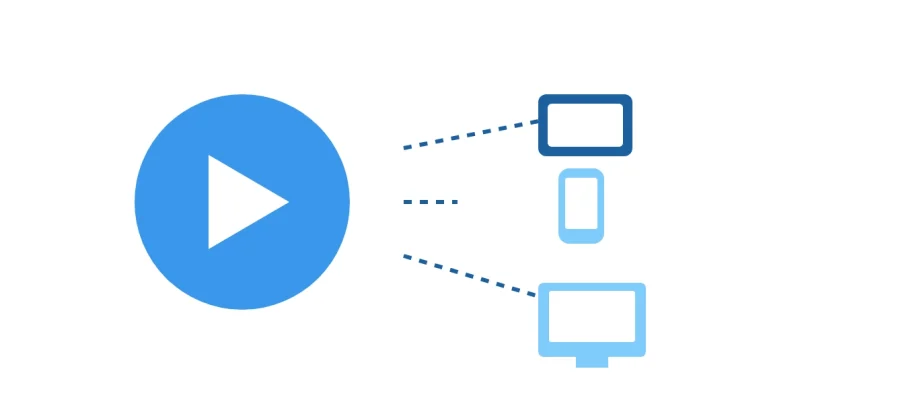
OTT stands for Over-The-Top — video delivered directly over the internet instead of through cable, satellite, or traditional broadcast. An OTT platform is the underlying software that stores, protects, and streams that video to viewers on whatever device they’re using: a phone, a laptop, a smart TV, or a streaming box.
This guide covers how OTT video delivery actually works end to end, the business models built on top of it, and the difference between using a finished OTT app and running your own OTT delivery infrastructure.
How Does OTT Video Delivery Work?
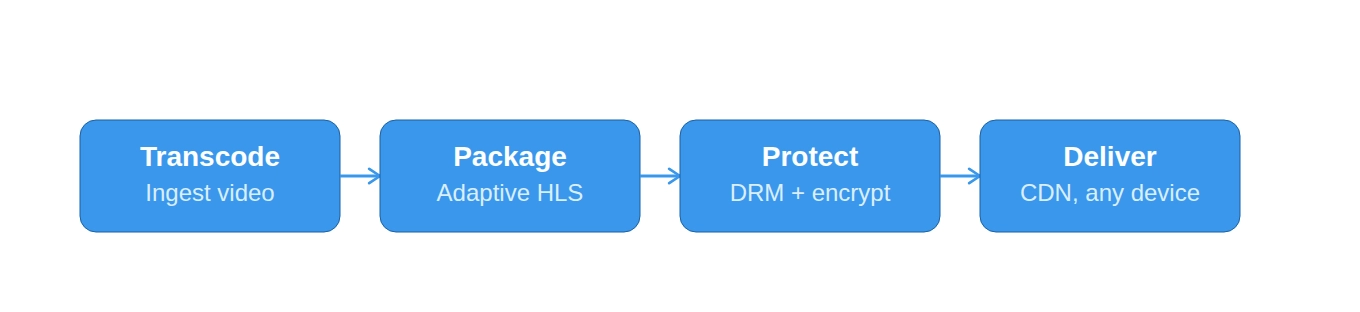
OTT delivery works by taking a source video through a pipeline — encoding, packaging, protecting, and distributing it — so it plays smoothly on any device without ever touching cable or satellite infrastructure. The same underlying pipeline powers everything from a course platform to a full-scale streaming service.
The core stages:
- Transcode — The source video is ingested and encoded into multiple quality levels (an adaptive bitrate ladder), the same process covered in our breakdown of DRM and content protection.
- Package — Those quality levels are organized into an adaptive streaming format — most commonly HLS, using M3U8 playlists — so a player can switch quality on the fly.
- Protect — DRM and access controls are applied so only authorized viewers can decrypt and play the stream.
- Deliver — A CDN distributes the packaged stream globally, so playback stays smooth regardless of where the viewer is.
What Does an OTT Platform Actually Do?
An OTT platform is the software layer that handles everything between “here’s my video file” and “a viewer is watching it securely on their TV” — most of which has nothing to do with the video itself. That includes:
- Hosting and storage for the video library.
- Transcoding and packaging into adaptive streaming formats.
- DRM and access control, so paid or private content stays protected.
- Sign-in and billing, for platforms with subscriptions or purchases.
- Analytics, tracking engagement, drop-off, and playback quality.
- Apps and players across phones, browsers, smart TVs, and connected devices.
OTT Business Models: SVOD, AVOD, TVOD, and FAST
OTT is a delivery method, not a business model — the same underlying pipeline supports several different ways to charge (or not charge) viewers. We covered the subscription model in depth in What Is SVOD?, and the other three models fill out the rest of the landscape:

- SVOD (Subscription) — A recurring fee for ongoing access to a library.
- AVOD (Advertising) — Free to watch, monetized through ads.
- TVOD (Transactional) — Viewers pay per title, rented or owned.
- FAST (Free Ad-Supported Streaming TV) — Free, ad-supported channels that mimic a scheduled broadcast lineup instead of on-demand browsing — one of the faster-growing OTT models recently.
Many OTT platforms blend more than one of these rather than picking just one.
OTT vs. Traditional Broadcast (and vs. IPTV)
The core difference between OTT and traditional TV is control: broadcast pushes a fixed schedule through dedicated infrastructure, while OTT lets viewers pull whatever they want, whenever they want, over the same internet connection they already have. IPTV sits in between — it also delivers video over IP, but through a managed private network run by a telecom or ISP, rather than the open public internet OTT relies on. IPTV suits closed environments like hotels or hospitals; OTT is built for open, direct-to-viewer reach.
Consumer OTT Apps vs. Business OTT Platforms — Where Inkrypt Fits In
It’s worth separating two things that both get called “OTT platform.” Consumer OTT apps — Netflix, Disney+, Hulu — are finished products with their own content libraries. A business OTT platform is the infrastructure that lets any business build and run that same kind of delivery for its own content, without building the pipeline from scratch.
That’s the layer Inkrypt Videos operates in — providing the transcoding, DRM protection, adaptive streaming, and CDN delivery that a course platform, enterprise, or media publisher needs to run their own OTT-style delivery, without needing an engineering team to build it. See our features or our comparison of business video hosting platforms for how this fits alongside other options.
Common Use Cases for OTT Delivery
- Course and coaching platforms delivering paid video content as a subscription or one-time purchase.
- Enterprise training portals distributing internal video securely across a workforce.
- Premium publishers and media companies running subscription or ad-supported content libraries.
- Live events, streamed the same way and often blended with an on-demand replay library afterward.