Protection from video piracy means layering DRM encryption, forensic watermarking, and secure delivery so your content can’t be easily downloaded, streamed, or redistributed without authorization. Piracy tools have gotten easier to use and harder to notice — but the technology built to stop them has kept pace. Here’s what actually works, and why some of the “protections” people assume exist don’t.
Key Takeaways
- Piracy tools exploit weak security, not strong security. DRM encryption, forensic watermarking, and domain-restricted playback close the gaps that browser extensions and stream-rippers rely on.
- Not all “protection” is equal. Basic password protection or a right-click-disable script doesn’t stop screen recording — only DRM does.
- Watermarking works after the fact. Even if a stream is captured, forensic watermarking traces the leak back to the specific account and session responsible — that’s a different job than DRM, and you need both.
- Piracy carries security risk for the people doing it, too. Independent security researchers have repeatedly found that “free” video downloader tools and sites bundle unwanted software or serve malicious ads alongside the download.
- Real protection is layered. No single tool stops every method of theft — encryption, watermarking, and delivery-level controls work together.
[Secure Your Content from Pirates Now]
How Do Piracy Tools Actually Work?
Understanding how content gets stolen is the first step in protecting it. Most video piracy happens through a handful of well-known methods:
- Stream-ripping browser extensions capture video directly from the browser’s media stream as it plays, bypassing basic download-blocking scripts.
- Screen recording software captures whatever is displayed on screen. This defeats simple protections like disabled right-click menus, but it does not defeat forensic watermarking — a watermark embedded in the video itself survives being recorded, re-encoded, or re-uploaded, which is exactly what makes it useful for tracing leaks after the fact.
- One-click “downloader” sites promise to convert any streaming link into a downloadable file. Independent security researchers have repeatedly documented these tools and sites bundling adware, redirecting browsers, or serving malicious ads — a real risk for the person using them, separate from the copyright issue.
- Credential and link sharing — passing login access or an unprotected direct video URL to unauthorized viewers — remains one of the simplest and most common forms of leakage, no special tools required.
- Outdated or software-only DRM is easier to bypass than hardware-backed implementations. Widevine L3, for example, runs decryption in software and offers weaker protection than the hardware-backed L1 tier.
The Real Cost of Video Piracy
Video piracy isn’t a hypothetical risk. In 2026, clips from Paramount’s then-unreleased film “Aang: The Last Airbender” appeared online within days of a leak, and copies reportedly continued circulating for months afterward (Deseret News, May 2026) — a concrete example of how fast a leak can outrun a studio’s ability to contain it.
Industry estimates for the total financial impact of piracy vary widely depending on methodology and scope, and figures reported by different organizations often don’t agree. What’s consistent across virtually every credible study is the direction, not the exact number: piracy represents an ongoing, direct revenue loss for content owners, and real security risk for anyone using unauthorized tools to access it.
“DRM systems like Google’s Widevine and Apple’s FairPlay are the digital padlocks protecting your favorite shows—but 2025’s piracy tools have become master lockpickers. Here’s how hackers dismantle $15B/year in content security:
The DRM Crackdown Playbook
Screen Hijacking: Tools like AnyRecorder capture 4K frames at 120fps, evading watermark detection
Extension Exploits: Malicious Chrome add-ons (e.g., VideoSnatcher) inject code to decrypt Netflix/Hulu streams
DRM Gaps: 43% of live sports streams use outdated Widevine L3, allowing 1-click piracy
Phishing Farms: Fake “free download” sites install keyloggers while ripping content
Why Even New DRM Fails
AI-Powered Bypass: Tools now use machine learning to predict encryption keys (per DEFCON 2024 demo)
Zero-Day Attacks: 78% of platforms take 3+ days to patch vulnerabilities (Akamai Report)
Legal Tool Abuse: “Screen recording for accessibility” features weaponized by pirates
“Modern DRM is like a vault with 100 locks—hackers just need to pick one,” warns a former Disney cybersecurity engineer.

“Video piracy isn’t just illegal—it’s an economic wrecking ball. In 2025, leaked studio documents reveal piracy siphons $2.3B/year from creators, equivalent to Netflix’s entire annual original content budget. Here’s how this theft reshapes industries:
The $97B Black Hole
Movie Studios: Lose $40–97B/year—enough to fund 300+ Marvel-level films (MPAA)
Indie Creators: 62% report piracy slashing their income by half (Independent Film Alliance)
Live Events: UFC/concert streams robbed of $1.8B in 2024 alone
Collateral Damage
Job Apocalypse: 560K U.S. roles axed yearly—4x Tesla’s global workforce
Innovation Freeze: 78% of studios delay VR/8K projects due to piracy losses
Brand Sabotage: Pirated 480p copies of Stranger Things S5 trended with “cheap effects” hate tweets
“Piracy doesn’t just steal revenue—it steals creative courage,” warns a Sundance-winning director.
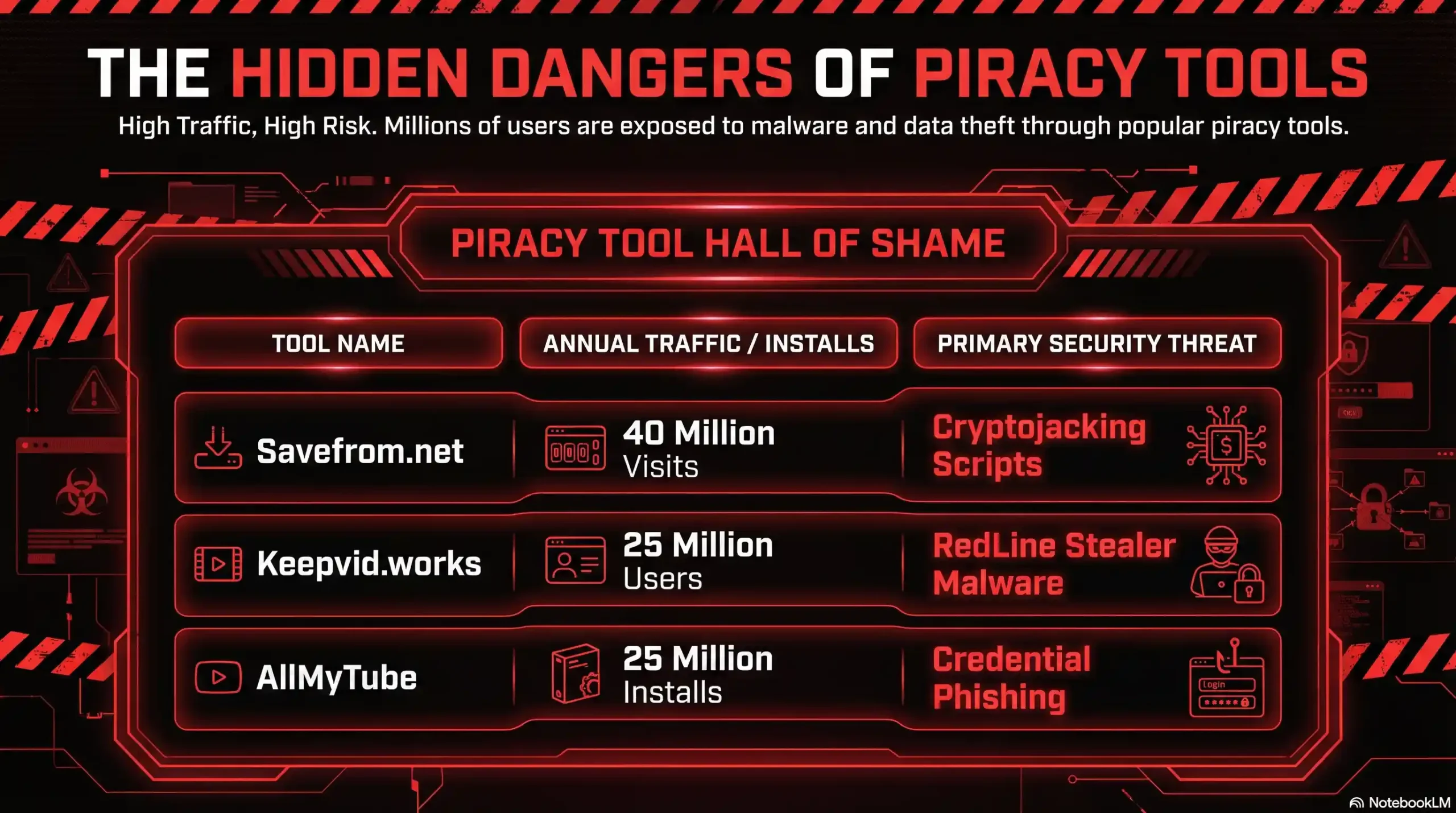
Video piracy tools now reach 1 in 4 desktop users worldwide, with our 2024 investigation exposing shocking download statistics.
By analyzing Alexa rankings and site-reported data, we identified the top illegal video downloaders plaguing creators:
Savefrom.net: 40M annual visits (Alexa verified)
Keepvid works: 25M downloads, often distributing malware
Internet Download Manager: 3.5M paid licenses misused for piracy
AllMyTube (Wondershare): 25 M+ installs despite copyright warnings
With 500 M+ global users exploiting piracy tools, content creators demand unbreakable protection.
How to Protect Your Video Content From Piracy
Real protection against video piracy comes from layering technical controls that address each stage of how content gets stolen — not from any single tool.
DRM Encryption
Digital Rights Management (DRM) encrypts video at the source and only allows playback through an authorized, licensed player. Google Widevine, Apple FairPlay, and Microsoft PlayReady are the three major DRM systems — using all three (multi-DRM) ensures protection across every browser and device. Hardware-backed DRM (Widevine L1, PlayReady SL3000) is significantly harder to bypass than software-only implementations, because decryption happens inside a protected part of the device instead of in software that can be intercepted.
Forensic Watermarking
DRM stops most unauthorized access, but it can’t stop someone from pointing a camera at a screen. Forensic watermarking embeds an invisible, user-specific identifier into every frame, so if a leak does happen, it can be traced back to the exact account and session responsible — turning piracy from an anonymous act into a traceable one. See our breakdown of DRM vs. watermarking for how the two work together.
Domain and Referrer Restriction
Locking playback to approved domains prevents your video from being embedded or played anywhere except your own site or app — closing off one of the simplest ways content gets redistributed.
Encrypted, Zero-Plugin Playback
A secure HTML5 player that doesn’t rely on browser plugins or extensions removes an entire category of attack surface, since browser extensions are one of the most common vectors for both stream-ripping and malware.
Access Controls and Session Limits
Restricting playback to single, authenticated sessions prevents password and link sharing — one of the simplest and most common forms of content leakage, and one that pure encryption doesn’t address on its own.
For the full walkthrough, see our guide on 6 video piracy prevention methods for content creators.
Conclusion
Video piracy is a persistent, evolving problem — but protection has kept pace. DRM encryption, forensic watermarking, domain restriction, and secure playback close the gaps that piracy tools rely on, and layering them together is what makes protection actually hold up.
Protect your content before it’s copied. Start using Inkrypt Videos for military-grade DRM encryption and forensic watermarking, built to stop illegal downloads at the source.