
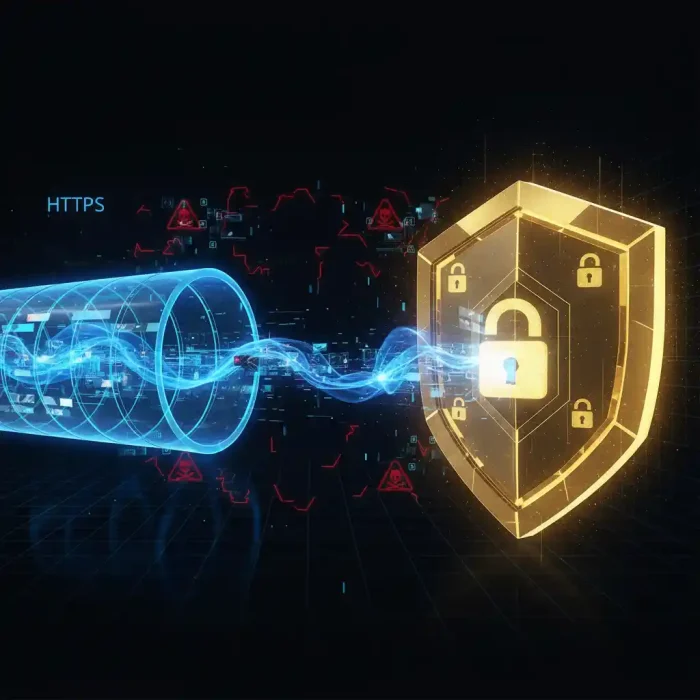
Does HTTPS protect premium video content from piracy? HTTPS encrypts the connection between a server and a browser, protecting data in transit — but it does not protect video content after delivery. Once a stream reaches a viewer’s device, HTTPS has no control over screen recording, stream ripping, or credential sharing. Premium video protection requires Multi-DRM encryption, dynamic watermarking, and tokenized delivery working together.
Every online course creator, enterprise media company, and premium content publisher making the decision to host their video content online faces the same critical question: is my content actually protected? The instinctive answer is usually “yes — we have HTTPS.” And that answer, while partially correct, is dangerously incomplete.
HTTPS is not video security. It is channel security. Understanding that distinction is the difference between content that is genuinely protected and content that only feels protected — until the day it isn’t.
This guide breaks down exactly where HTTPS stops working, what real threats are waiting on the other side, and what a complete, enterprise-grade video security stack actually looks like in 2026.
What HTTPS Actually Does (And What It Doesn’t)
The Lock on the Front Door — Understanding Transport Layer Security
HTTPS — Hypertext Transfer Protocol Secure — is built on TLS (Transport Layer Security), a cryptographic protocol that creates an encrypted tunnel between a web server and a user’s browser. Think of it as a locked, armored truck transporting your video data from point A to point B. Nobody can intercept or tamper with the package while it’s in transit.
This is genuinely valuable. Without HTTPS, man-in-the-middle attacks could intercept unencrypted video streams mid-delivery, injecting malicious content or stealing session tokens. HTTPS eliminates that class of threat entirely, and for that reason, it is an absolute baseline requirement for any online content platform.
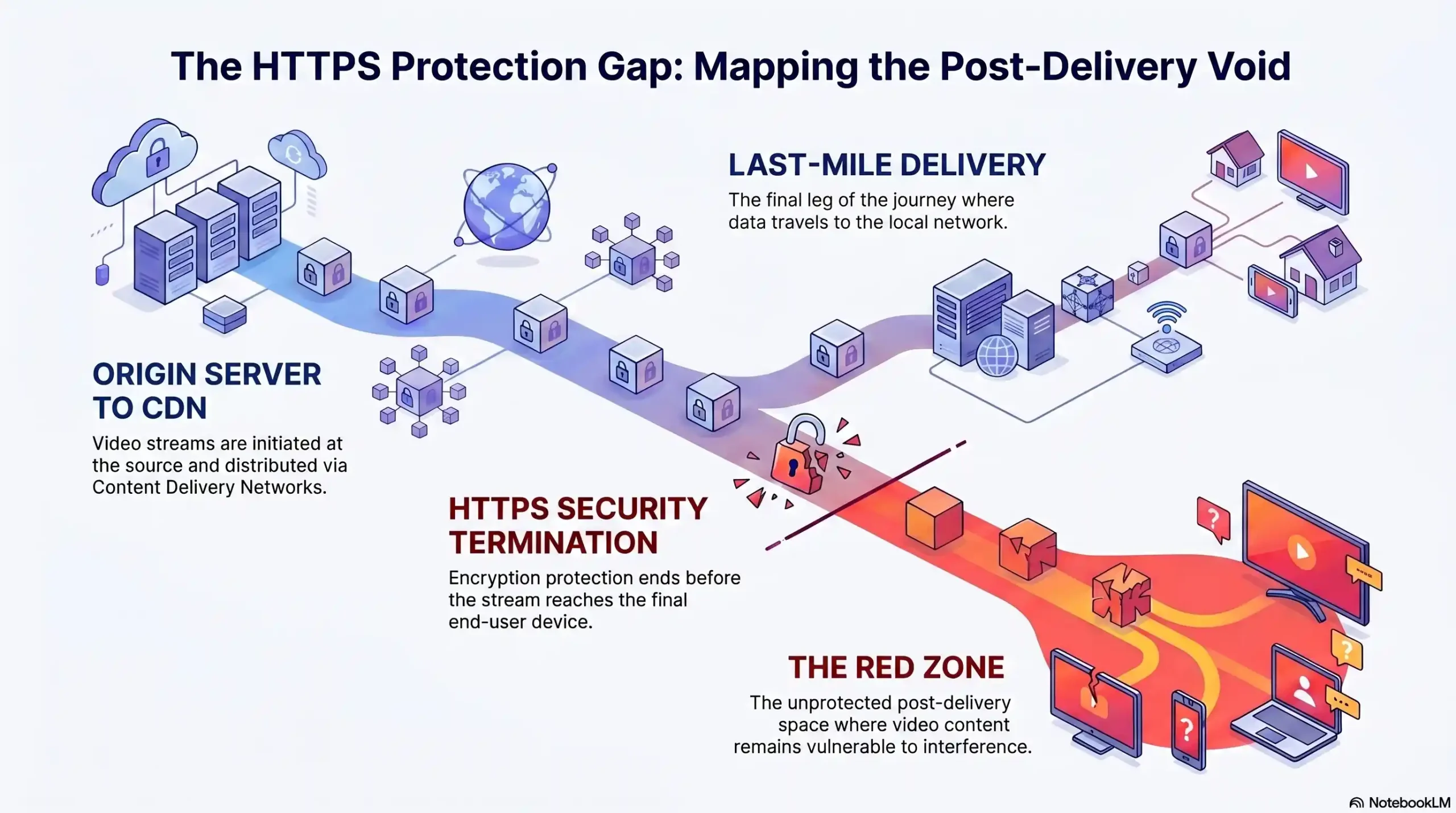
But here is where the metaphor breaks down entirely: the moment that armored truck arrives at its destination and the package is handed over, the truck drives away. Whatever happens next is no longer its concern.
Where HTTPS’s Protection Ends: The Last-Mile Vulnerability
The “last mile” in video delivery is the space between your CDN edge server and the actual playback device — the laptop, phone, or smart TV in your viewer’s hands. HTTPS secures the journey. It has no authority over the destination.
Once your video stream is decrypted at the device level for playback — which it must be, or the user cannot watch it — it exists in a decrypted, accessible state. At that precise moment, HTTPS protection is functionally over. The content is now exposed to whatever tools or intentions the end user brings to that session.
The Three Threats HTTPS Was Never Designed to Stop
HTTPS was designed by engineers solving a specific problem: secure data transmission. It was never designed to address post-delivery content exploitation. The three threats it categorically cannot prevent are:
1. Content capture at the device level — screen recorders and stream rippers operate after decryption, where HTTPS has no jurisdiction.
2. Credential and link sharing — HTTPS authenticates the connection, not the identity or exclusivity of the viewer using it.
3. Unauthorized redistribution — once content is downloaded or captured, HTTPS has no mechanism to track, trace, or revoke it.
Data in Transit
- Threat covered: Man-in-the-middle attack
- HTTPS covers? ✅ Yes
- DRM required? ❌ No
Content at Device Level
- Threat covered: Screen recording/ripping
- HTTPS covers? ❌ No
- DRM required? ✅ Yes
Viewer Identity
- Threat covered: Credential sharing
- HTTPS covers? ❌ No
- DRM required? ✅ Yes
Post-Delivery Tracking
- Threat covered: Unauthorized redistribution
- HTTPS covers? ❌ No
- DRM required? ✅ Yes
Link Security
- Threat covered: URL sharing/hijacking
- HTTPS covers? ❌ No
- DRM required? ✅ Yes
The Real Threat Landscape for Premium Video Content
Stream Ripping — The Silent Revenue Killer
Stream ripping tools — software designed to capture and download video streams during playback — are widely available, free, and require no technical expertise to operate. A course creator selling a $997 program can have their entire curriculum downloaded, redistributed on Telegram, and shared across piracy forums within hours of a single student gaining access.
The damage is rarely visible immediately. Enrollment numbers drop gradually. Refund requests increase. The creator assumes the market has shifted — when in reality, their content is circulating freely. Stream ripping is silent, scalable, and entirely invisible to HTTPS.
Screen Capture & Recording Tools: Impossible to Block Without DRM
Modern operating systems include native screen recording capabilities. Third-party applications add professional-grade capture with audio. Without DRM enforcement at the hardware level — specifically Widevine L1 on Android and PlayReady SL3000 on Windows — there is no technical mechanism within an HTTPS-only environment to prevent a viewer from recording your premium video content in full HD.
This is not a gap that can be patched with terms of service language or watermark overlays. It requires hardware-level DRM enforcement that instructs the device’s secure enclave to refuse rendering to screen capture APIs.
Credential Sharing & Link Hijacking
A single purchased account shared across twelve users is not a hypothetical — it is standard behavior among cost-conscious consumers. HTTPS authenticates the encrypted session, but it does not enforce viewer uniqueness, device limits, or geographic restrictions. One login can become thirty viewers without triggering a single HTTPS-level alert.
Link hijacking follows a similar pattern. A tokenless, unprotected video URL embedded in an HTTPS page can be extracted from browser developer tools in under sixty seconds and shared globally. HTTPS delivered that URL securely — and then stood by while it was weaponized.
Man-in-the-Middle Attacks Beyond the Browser
While HTTPS eliminates classical man-in-the-middle attacks at the network layer, sophisticated actors operating within enterprise environments — on corporate proxies, VPNs, or compromised routers with SSL inspection enabled — can intercept and inspect HTTPS traffic in ways that basic TLS implementations do not anticipate. For enterprise media companies handling high-value content, this represents a non-trivial attack surface that transport-layer security alone cannot close.
🎯 Concerned about what HTTPS is leaving exposed? Inkrypt Videos closes every one of these gaps with enterprise-grade DRM, forensic watermarking, and tokenized delivery.
Tokenized URLs & Signed Delivery — Closing the Link-Sharing Loophole
How Tokenized URLs Work in HLS and MPEG-DASH Streams
A tokenized URL is a dynamically generated, time-limited, cryptographically signed stream URL that is unique to each authorized playback session. Unlike a static video URL — which, once extracted, can be shared and accessed indefinitely — a tokenized URL expires after a defined window, is bound to a specific IP address or device fingerprint, and becomes invalid the moment the authorized session ends.
In HLS and MPEG-DASH streaming protocols, tokenization is applied at the manifest level, meaning every segment request within the stream carries authentication. Extracting a single segment URL provides no usable access to the stream as a whole.
Session-Bound Playback — Tying a Stream to One Authorized Viewer
Session-bound playback extends tokenization by linking the stream not just to a URL but to a validated, authenticated user session with enforced constraints — maximum concurrent streams per account, geographic IP validation, device fingerprint matching, and time-of-day access windows. A shared login that worked yesterday becomes non-functional the moment session binding detects anomalous concurrent access.
Amazon CDN + Token Authentication: The Infrastructure Behind Inkrypt Videos
Inkrypt Videos delivers all protected content via Amazon CloudFront CDN — one of the world’s largest and most performant content delivery networks, with 750+ points of presence across 100+ cities in 50+ countries — with token authentication enforced at the edge. This means every stream request is authenticated at the CDN level before a single byte of video data is delivered. Unauthorized requests are rejected at the infrastructure layer, not after delivery. The result is both maximum security and zero-latency performance for authorized viewers worldwide.
The True Cost of “Good Enough” Security — What Piracy Is Costing You Right Now
Revenue Loss Statistics for Online Course Creators
The global e-learning piracy problem is not a fringe issue. Industry estimates suggest that for every legitimate sale of premium educational content, between 1.5 and 3 unauthorized copies are in circulation. For a course creator generating $200,000 annually, this implies a potential revenue leakage of $100,000 to $300,000 per year — invisible, ongoing, and entirely preventable with the right security infrastructure.
The Reputational Damage of a Content Leak for Enterprise Media
For enterprise media companies, the cost of a content leak extends far beyond immediate revenue loss. A leaked pre-release film or proprietary training series damages distribution agreements, violates licensing contracts, and triggers liability clauses. The reputational signal to partners and investors — that the company cannot secure its own assets — can suppress deal-making for quarters after the incident is resolved.
Calculating Your Content’s Risk Exposure
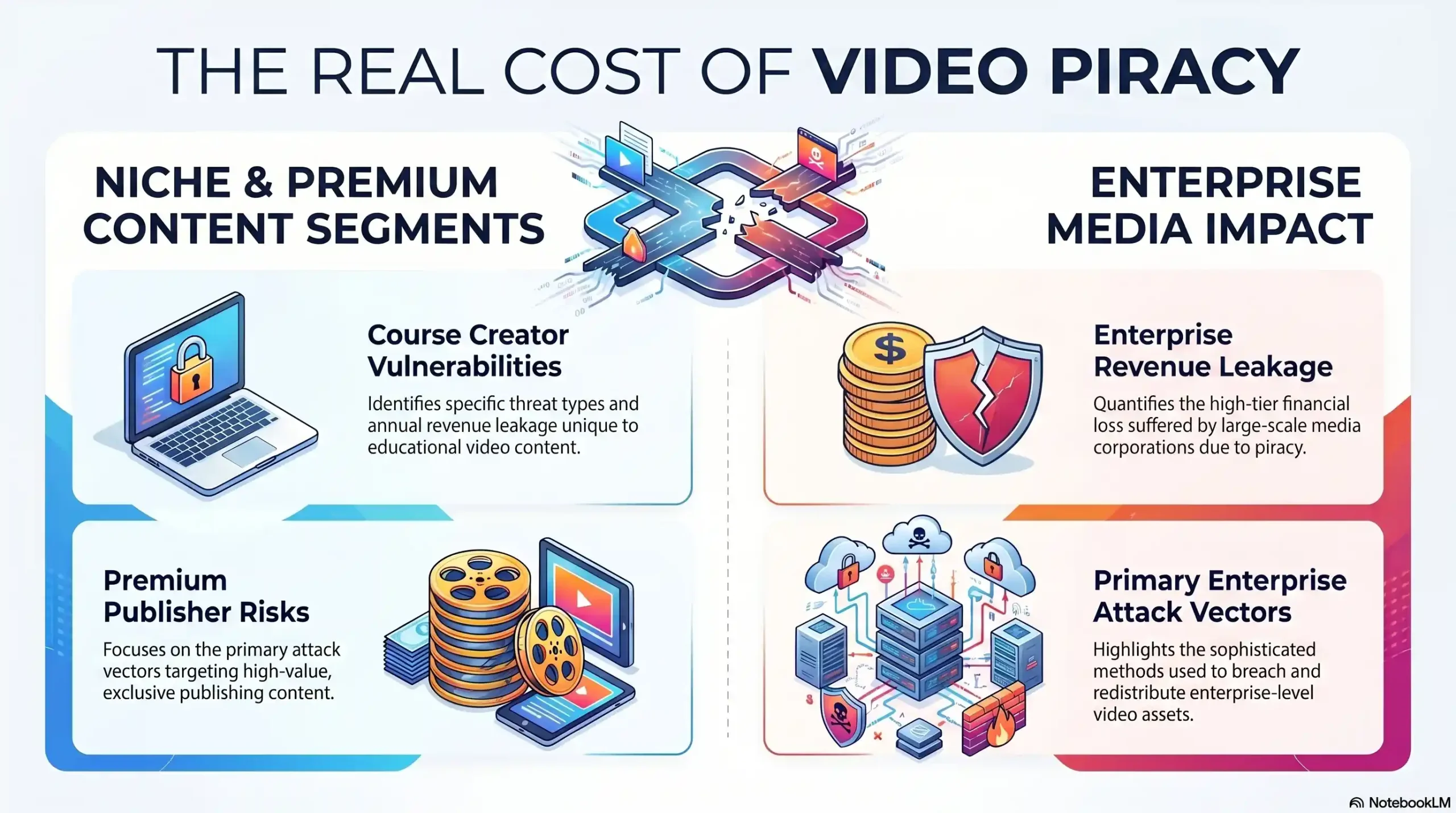
Online Course Creators
- Average content value: $500 – $5,000 per course
- Piracy risk level: High
- Estimated annual leakage: 30–60% of revenue potential
- Primary threat: Stream ripping & credential sharing
- Recovery time: 6–18 months
Enterprise Media Companies
- Average content value: $50K – $500K per title
- Piracy risk level: Critical
- Estimated annual leakage: $100K – $2M+ per incident
- Primary threat: Content leaks & DRM bypass
- Recovery time: 12–36 months
Premium Publishers
- Average content value: $10K – $100K per content library
- Piracy risk level: High
- Estimated annual leakage: 20–40% subscriber revenue
- Primary threat: Credential sharing & link hijacking
- Recovery time: Ongoing
What a Complete Video Security Stack Looks Like in 2026
Layer 1 — Transport Security (HTTPS/TLS — The Baseline)
The foundational layer. Mandatory, non-negotiable, and entirely insufficient on its own. Secures the delivery channel only.
Layer 2 — Content Encryption (AES-128 + Multi-DRM)
Encrypts video segments and protects decryption keys inside hardware-secured enclaves. Prevents stream ripping and screen capture at the OS level. Widevine, PlayReady, and FairPlay working in concert.
Layer 3 — Forensic Watermarking & Identity Tracking
Embeds unique, invisible identifiers per viewer session. Survives re-encoding and compression. Provides legal-grade evidence for breach investigation and prosecution.
Layer 4 — Tokenized Delivery & Session Management
Cryptographically signed, time-limited, session-bound URLs. Concurrent stream limits. Geographic and device-level access controls. Eliminates link sharing and credential abuse.
Layer 5 — Real-Time Analytics & Threat Intelligence
Continuous monitoring of playback sessions for anomalous behavior — unusual geographic access, concurrent session spikes, abnormal playback patterns. Threat signals are surfaced in real time, enabling immediate access revocation before damage escalates.
Why Inkrypt Videos Is the Complete Security Stack — Not Just Another Tool
30-Minute Setup vs. Weeks of Enterprise Configuration
Enterprise DRM implementations from legacy vendors routinely require weeks of developer time, custom SDK integration, and dedicated DevOps resources. Inkrypt Videos compresses that timeline to thirty minutes through purpose-built WordPress plugins, clean REST APIs, and a zero-configuration CDN architecture that arrives pre-integrated with Amazon CloudFront. Security that is too complex to implement is security that never gets implemented.
Global Delivery via Amazon CDN — Zero Buffering, Maximum Protection
Content protection that degrades playback performance is a false trade-off that Inkrypt Videos refuses to accept. By routing all protected streams through Amazon CloudFront’s global edge network, Inkrypt Videos delivers DRM-encrypted content with the same load performance as unprotected streams. Your viewers in Cairo, São Paulo, or Seoul experience zero buffering. Your content remains protected at every edge node.
Universal Device Compatibility — No Viewer Left Behind
Legacy DRM implementations frequently break on older devices, obscure browsers, or non-standard operating systems — creating support burdens and viewer churn. Inkrypt Videos maintains full playback compatibility across all modern and legacy device categories, ensuring that your security infrastructure never becomes a barrier to your audience’s access.
🏛️ Local Resources & Citations
1. W3C — Encrypted Media Extensions (EME) Specification The official W3C standard that defines how browsers communicate with DRM systems like Widevine, PlayReady, and FairPlay — reference this to verify the technical architecture behind Multi-DRM playback described in the article.
2. NIST — Cybersecurity Framework 2.0 (CSF 2.0) The U.S. government’s official cybersecurity risk management framework — reference this to validate the layered security stack approach recommended in the article, particularly the Protect and Detect functions that align directly with DRM and forensic watermarking strategies.
3. WIPO — Copyright & Internet Treaties (WCT & WPPT) The UN’s World Intellectual Property Organization governs the international legal framework that protects digital content from unauthorized access and distribution — reference this for the global legal basis underpinning content protection rights that DRM enforces technically.
4. IETF — RFC 8446: TLS 1.3 Official Protocol Specification The Internet Engineering Task Force’s official specification for TLS 1.3 — the protocol that powers HTTPS — reference this to demonstrate precisely what TLS was designed to do (and not do), directly supporting the article’s core argument that HTTPS is a transport-layer tool only.
Conclusion — Real Security for Real Creators
HTTPS is not your enemy — it is simply not your solution. It was built for a different problem, and asking it to protect premium video content from post-delivery exploitation is like asking a postal service to prevent someone from photocopying a letter after it’s been delivered. The transport was secure. The destination was not.
Real content protection in 2026 requires a layered, forensic-grade security architecture: Multi-DRM encryption at the hardware level, dynamic watermarking that survives redistribution, tokenized delivery that eliminates link sharing, and real-time analytics that detect threats before they become incidents.
That architecture exists. It is live, it is deployable in thirty minutes, and it is built for creators and enterprises who understand that their content is not just media — it is their business.
Inkrypt Videos. Real security for real creators.
🎯 Every layer of the complete video security stack is live inside Inkrypt Videos — deployed in thirty minutes, operating worldwide. Start protecting your premium content today. 🌐 Visit: inkryptvideos.com