
Protecting your educational content from digital piracy requires more than simple passwords—it requires DRM-encrypted streaming and dynamic watermarking. Credential sharing alone can meaningfully erode course revenue, since one paid account can end up serving several unauthorized viewers. Implementing proper video security is one of the most direct ways to protect that revenue and convert casual content-sharers into paying students.
Calculate Your Protected Revenue Potential
Understanding the Financial Impact of Course Piracy
The Real Cost of Unprotected Content
Course piracy isn’t just about losing individual sales—it’s about systematic revenue erosion that compounds over time. Password sharing is a particularly damaging pattern: a single set of credentials can end up serving several unauthorized viewers instead of one paying student.
Consider a simple illustration: if a $500 course with 100 legitimate students were instead serving 400 actual users through shared logins, that’s a meaningful share of potential revenue going uncollected on that course alone — and the effect compounds across a full catalog of courses.
This is a well-documented problem at scale: one leading DRM provider reported blocking over 120,000 illicit streaming sessions in a recent six-month period alone. Each blocked session represents a potential sale lost to piracy, which is why security investments are best thought of as protecting revenue you’re already earning, not just adding cost.
Industry-Specific Vulnerabilities
Different course types face varying piracy risk, particularly relevant for e-learning platforms and online education providers. Higher-value, in-demand categories — technology and programming courses, business and marketing strategies, professional certification programs, high-ticket coaching — tend to attract more piracy attempts than lower-demand categories like creative skills or language learning, simply because there’s more resale value in a leaked copy.
Understanding your risk level helps justify security investments: the more in-demand and valuable your course category, the more a layered DRM and watermarking approach pays for itself, while lower-risk content may only need basic protection.
Essential Security Technologies: What Works and What Doesn’t
DRM Encrypted Video Streaming: Your First Line of Defense
DRM technology represents the most effective protection against unauthorized access. Unlike simple password protection that can be easily bypassed, modern DRM creates encrypted pathways — using systems like Widevine, FairPlay, and PlayReady — that make content theft extremely difficult, since the video never exists in an unprotected, capturable format during playback.
Key DRM Benefits for Course Creators:
- Screen recording prevention at the hardware level, on supported devices
- Device-specific licensing that prevents credential sharing
- Automatic key rotation that invalidates stolen access
- Cross-platform protection covering all viewing devices
- Straightforward integration into existing course websites
Platforms built specifically for course creators, like Inkrypt Videos, bundle this technology directly into hosting so you don’t need in-house DRM expertise to implement it.
Video Watermarking Technology: Accountability That Deters Theft
Dynamic watermarking embeds unique user identifiers directly into video streams, creating powerful psychological deterrence — students think twice about screen-recording a video that visibly displays their own email address.
Watermarking Features That Matter:
- User-specific overlays showing email addresses or account information
- Position rotation that prevents easy removal
- Invisible embedding that survives re-encoding and compression
- Legal evidence quality for pursuing copyright violations
The deterrent effect tends to matter as much as the technical protection: simply knowing content is watermarked makes casual sharing feel personally traceable, which discourages it before it happens.
Secure Video Hosting Infrastructure: Scalable Foundation
Professional secure video hosting provides the foundation for comprehensive protection — the encryption and watermarking layers above only matter if the underlying platform is genuinely built for security.
Essential Platform Features to Look For:
- Cloud architecture that scales without storage limitations
- Domain restrictions preventing unauthorized embedding
- Geo-blocking for region-specific content control
- Token-based access with automatic URL expiration
- CDN-level encryption for consistent global performance
- Real-time analytics for threat detection
Platforms purpose-built for course creators — rather than general-purpose video hosts — tend to bundle these features together instead of requiring separate integrations for each one.
Cost-Benefit Analysis: Making the Business Case
Investment Requirements and ROI Calculations
Security costs vary widely depending on how much protection your content needs — from lightweight DRM-only setups for smaller catalogs to full enterprise suites with dedicated monitoring for high-volume platforms. It’s worth pricing this against the specific revenue at risk rather than defaulting to the most comprehensive tier available.
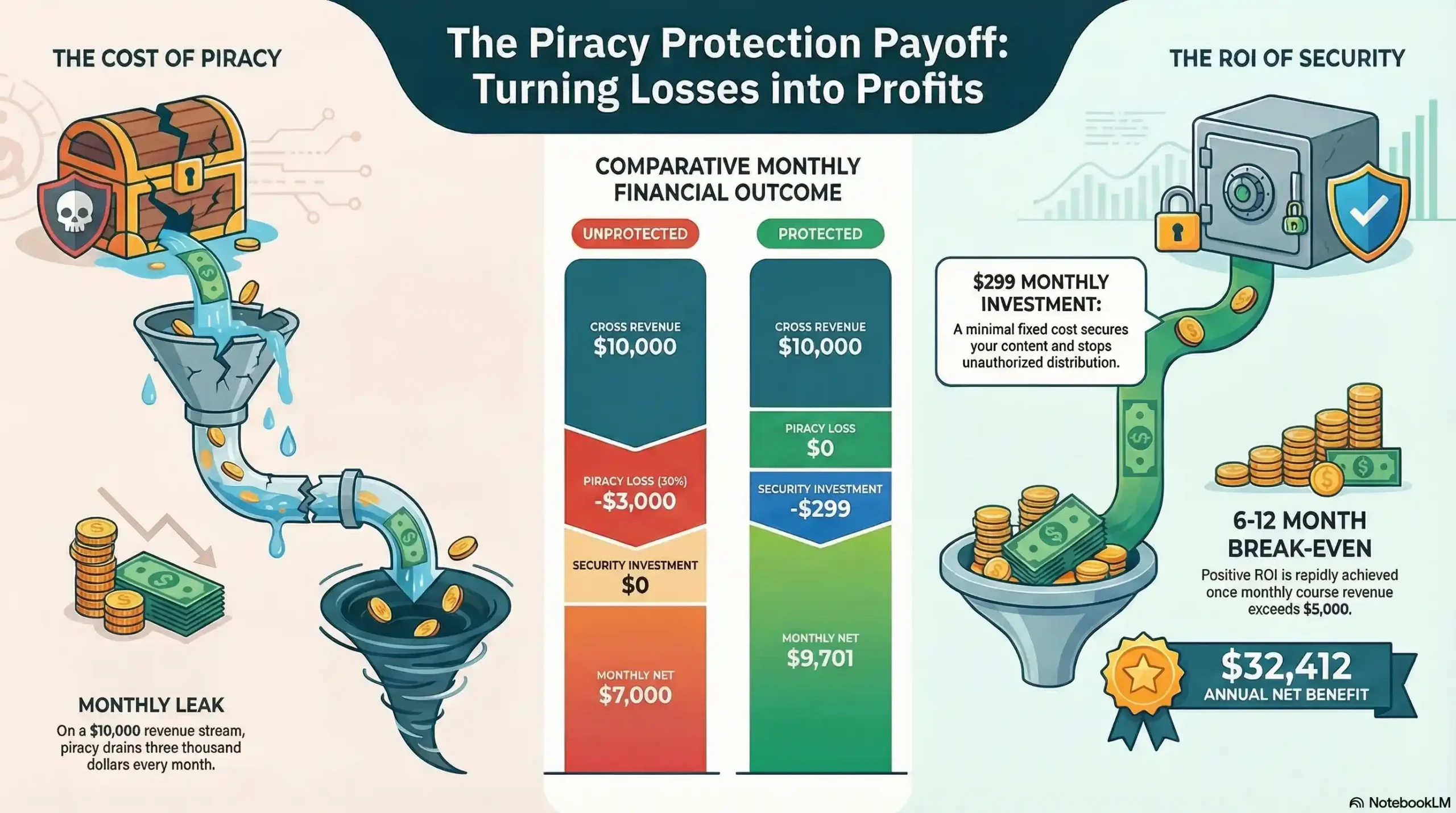
A simple way to think about ROI: if a $10,000/month course generates even a conservative 10% in piracy-related revenue loss, that’s $1,000/month in losses to weigh against your security platform’s monthly cost. For most course creators generating meaningful revenue, that math tends to favor investing in proper protection well before reaching enterprise scale.
When evaluating platforms, look for ones that bundle DRM encryption, watermarking, and secure hosting together rather than requiring you to stitch together multiple vendors and integrations yourself — that combination tends to be both cheaper and easier to maintain than a build-your-own approach.
Implementation Strategy: A Phased Approach
Phase 1: Foundation Security (Months 1-3)
Immediate Actions:
- Platform Migration: Move to video hosting with built-in DRM protection
- Content Upload: Transfer existing courses to the secure platform
- Website Integration: Embed protected videos using the platform’s integration tools
- Watermarking Setup: Enable dynamic watermarking across all content
- Basic Analytics: Monitor viewing patterns and security alerts
Business Impact: This foundational layer eliminates casual, opportunistic piracy — the majority of unauthorized sharing — and gives your course an immediately more professional, secure appearance to students.
Phase 2: Advanced Protection (Months 4-9)
Advanced Implementation:
- Full Security Suite: Extend DRM protection across your entire content library
- Performance Optimization: Leverage CDN delivery for a consistent experience at scale
- Advanced Watermarking: Expand content tracking to cover every course
- Analytics Integration: Use detailed reporting to understand where risk is concentrated
- Community Development: Add interactive elements that increase the value of legitimate access
Business Impact: At this stage, protection becomes comprehensive enough to meaningfully affect conversion and retention, since students see fewer reasons to look for pirated alternatives.
Phase 3: Enterprise Security (Months 10+)
Complete Protection Strategy:
- Custom Integration: API-level security tailored to unique business requirements
- Advanced Monitoring: Comprehensive threat detection and response
- Legal Framework: Establish IP protection and enforcement capabilities
- Global Scaling: Multi-region content delivery with local compliance
- Partnership Integration: Enterprise-level security for platform partnerships
Business Impact: This level of investment typically makes sense once you’re operating at a scale where premium pricing and enterprise partnerships are realistic goals — the security infrastructure becomes part of what makes those deals possible.
Measuring Success: KPIs That Matter for E-Learning Platforms
Revenue Protection Metrics
Primary Indicators to Track:
- Conversion Rate: Watch for improvement as fewer prospects can access your content for free through pirated copies
- Customer Lifetime Value: Track whether reduced churn follows from students no longer having a free alternative to fall back on
- Revenue Per User: Should trend upward as piracy alternatives become less viable
- Content Monetization: Track your ability to charge premium prices once protected content commands more trust
Security Performance Metrics
Operational Indicators:
- Piracy Incident Frequency: Set your own baseline and track reduction over time
- Content Protection Rate: Monitor how effectively your system blocks unauthorized access attempts
- User Satisfaction: Confirm security measures aren’t creating friction for legitimate students
- Technical Support: Track whether integrated solutions reduce support burden compared to piecemeal tools
Recommended Action Plan Based on Business Size
The right starting point depends heavily on scale — an individual creator and an established platform have very different priorities, even though the underlying technologies (DRM, watermarking, secure hosting) are the same.
For Individual Course Creators
Priority: Implement comprehensive protection with minimal complexity — look for a platform that bundles DRM, watermarking, and hosting rather than requiring separate tools. Timeline: Implement with your existing content as soon as practical.
For E-Learning Startups
Priority: Scalable security that grows with the business, with CDN performance and analytics built in from the start. Timeline: Implement before major marketing campaigns, so growth doesn’t outpace your protection.
For Established Educational Platforms
Priority: Enterprise-grade security with global CDN performance and dedicated support. Timeline: Phased migration that maintains service continuity rather than a disruptive full cutover.
Future-Proofing Your Content Security
Emerging Threats and Technologies
AI-Powered Piracy: AI tools increasingly make it faster and easier to strip and repackage stolen content, which raises the bar for how quickly detection and response need to happen. Blockchain verification systems are also emerging as a way to create tamper-proof ownership records.
Advanced Protection Response:
- Machine Learning Detection: AI systems that identify piracy attempts in real-time
- Behavioral Analytics: User pattern recognition that flags credential sharing before it scales
- Quantum-Resistant Encryption: Longer-term security planning against emerging cryptographic threats
Look for a security provider that treats these as an active roadmap rather than a one-time implementation, since piracy techniques will keep evolving.
Competitive Advantages of Early Adoption
Market Positioning Benefits:
- Premium Pricing Capability: Secured content commands higher prices
- Professional Credibility: Security measures signal serious business operations
- Partnership Opportunities: Secure creators attract enterprise clients and platform partnerships
- Scalability Preparation: Infrastructure ready for rapid business growth
Course creators who implement comprehensive security early position themselves to attract higher-value customers and partnership opportunities as they scale.
Getting Started with Inkrypt Videos
Contact and Implementation
Inkrypt Videos Contact Information:
- Website: https://inkryptvideos.com
- Features Information: https://inkryptvideos.com/features/
- Pricing Details: https://inkryptvideos.com/pricing/
- Contact: https://inkryptvideos.com/contact-us/
Implementation Process:
- Initial Consultation: Assess your specific content protection needs
- Platform Setup: Configure DRM-encrypted video streaming for your content
- Content Migration: Transfer existing courses to a secure cloud video platform
- Website Integration: Implement video hosting with minimal technical requirements
- Training and Support: Learn to maximize video watermarking and analytics capabilities
Service Portfolio
- Secure, DRM-encrypted video hosting with Widevine, FairPlay, and PlayReady support
- Dynamic video watermarking for content tracking
- Global CDN delivery for consistent performance
- Website integration tools for embedding protected content
Sources and Citations
This guide draws on industry research and published data. The following resources provide additional depth on the statistics referenced above:
- ElectroIQ – Piracy Statistics, Trends, And Facts
- Key Data: $75 billion in annual digital piracy losses industry-wide, global anti-piracy market valued at $236.2 billion
- VdoCipher – E-learning Video Protection Report
- Key Data: 120,000 illicit streaming sessions blocked in a recent six-month period, India’s ₹2,000 crore annual e-learning piracy losses
- DoveRunner – Content Piracy Predictions for 2025
- Key Data: $125 billion projected piracy losses by 2028, roughly 11% annual growth rate in content piracy losses
Conclusion: Security as a Growth Strategy
Secure online course videos and comprehensive course content security are no longer optional extras—they’re fundamental business requirements for serious educational entrepreneurs. A layered approach combining DRM-encrypted streaming, dynamic watermarking, and secure hosting addresses the problem from every angle: prevention, deterrence, and traceability.
Security investments are worth thinking of as protecting revenue you’re already earning, not just adding cost — every pirated copy represents a student who could have paid for legitimate access.
The choice is straightforward: implement robust protection now, or continue losing revenue to piracy that only gets more sophisticated over time.
Your next step: If you’re ready to evaluate a platform that combines DRM encryption, watermarking, and secure hosting in one integrated solution, Inkrypt Videos is built specifically for content creators who want enterprise-grade protection without enterprise complexity.