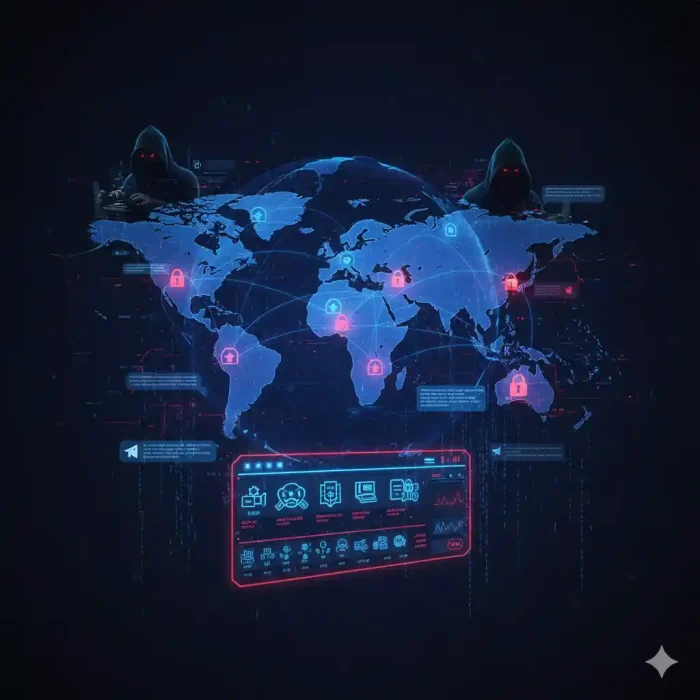
Course piracy networks are organized criminal ecosystems that systematically steal, repackage, and resell premium digital courses and educational content through dark web marketplaces, Telegram groups, and credential-sharing platforms. These underground economies cost content creators and e-learning platforms an estimated $74 billion annually in lost revenue globally, operating with the same sophistication as legitimate digital businesses — complete with tiered pricing, reseller programs, and customer support channels.
The moment a creator publishes a premium online course, a clock starts ticking. Somewhere in the invisible layers of the internet — inside encrypted Telegram channels, on dark web storefronts, and across credential-sharing forums — the machinery of an entire underground economy begins assessing, targeting, and monetizing that content. This is not the work of lone pirates with too much free time. This is organized, profitable, and growing.
Understanding how course piracy networks operate is no longer optional for serious content creators, e-learning platforms, or enterprise media companies. It is a matter of financial survival.
1. What Is the Course Piracy Underground Economy?
1.1 — Defining the Threat: More Than Casual Downloading
Most creators imagine content piracy as a single bad actor downloading a video and sharing it with a friend. The reality is categorically different. Course piracy networks are structured criminal enterprises with defined roles, revenue models, and distribution infrastructure. They function less like opportunistic theft and more like a shadow version of the legitimate digital distribution industry they are parasitizing.
These networks acquire premium course content through multiple vectors — compromised platform accounts, inside-access exploitation, screen recording operations, and increasingly, automated credential stuffing attacks that bypass login security at scale. Once acquired, content is not simply uploaded and shared. It is processed, rebranded, bundled, and sold through tiered distribution channels designed to maximize revenue while minimizing exposure to legal action.
The sophistication of these operations mirrors legitimate SaaS businesses. Some networks maintain customer service channels, offer “subscription” access to libraries of stolen courses, and even provide refunds to maintain seller ratings on underground marketplaces. This is not casual piracy. This is a business.
1.2 — The Scale: How Much Are Creators Actually Losing?
The financial damage inflicted by course piracy networks is staggering and systematically underreported. The global e-learning market is projected to exceed $400 billion by 2026, and industry analysts estimate that 15–20% of premium course revenue is lost annually to piracy and unauthorized distribution.
For an individual creator generating $200,000 per year in course sales, that represents $30,000–$40,000 in annual losses — revenue that disappears silently, never appearing in any refund report or analytics dashboard. For enterprise platforms operating at scale, the losses compound into tens of millions of dollars per year.
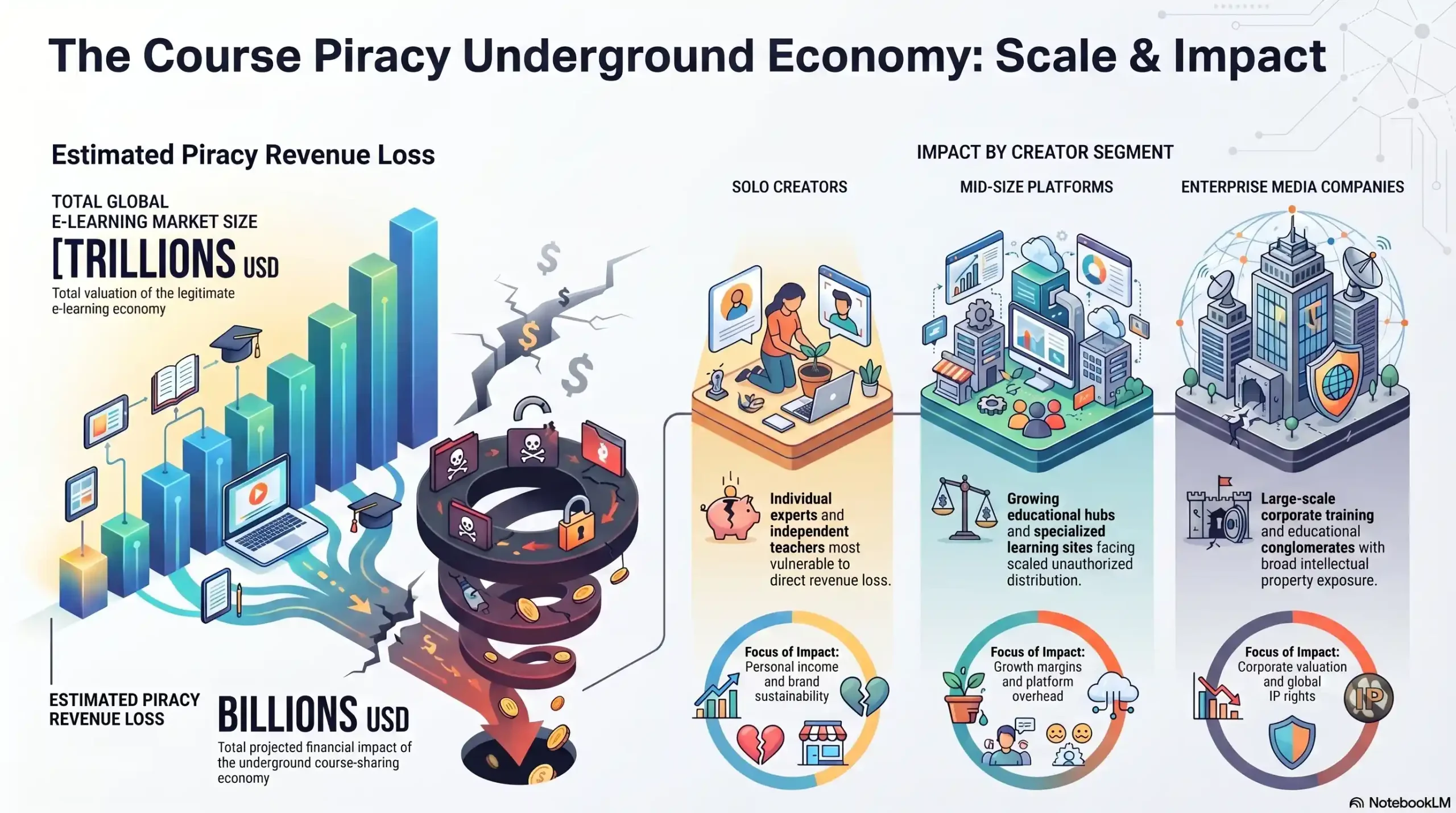
Solo Course Creator
- Est. annual revenue: $50K–$200K
- Est. piracy loss (15–20%): $7,500–$40,000
- Primary attack vector: Credential sharing, screen recording
Mid-Size E-Learning Platform
- Est. annual revenue: $500K–$5M
- Est. piracy loss (15–20%): $75K–$1M
- Primary attack vector: Credential stuffing, account reselling
Enterprise Media Company
- Est. annual revenue: $10M+
- Est. piracy loss (15–20%): $1.5M–$3M+
- Primary attack vector: DRM bypass, organized reseller networks
Educational Institution
- Est. annual revenue: $1M–$20M
- Est. piracy loss (15–20%): $150K–$4M
- Primary attack vector: Bulk credential theft, content leakage
2. Anatomy of a Course Piracy Network
2.1 — The Supply Chain: From Theft to Sale in 5 Steps
Understanding the piracy supply chain is the first step to dismantling it. Every piece of stolen course content passes through a remarkably consistent five-stage process before it generates revenue for those who stole it.
Step 1 — Acquisition: Content is obtained through compromised credentials, screen recording software, or exploited platform vulnerabilities. High-value courses are specifically targeted based on price point and market demand.
Step 2 — Processing: Raw stolen content is stripped of original watermarks where possible, re-encoded to remove identifying metadata, and in some cases, rebranded with alternative titles to evade automated detection systems.
Step 3 — Staging: Processed content is uploaded to hosting infrastructure deliberately chosen for its legal inaccessibility — servers in jurisdictions with weak IP enforcement, bulletproof hosting providers, or distributed file-sharing networks resistant to takedown requests.
Step 4 — Distribution: Staged content is listed across multiple channels simultaneously — dark web marketplaces, private Telegram channels, Discord servers, and surface-web “course dump” websites that operate in DMCA safe harbor gray zones.
Step 5 — Monetization: Networks generate revenue through one-time sales of individual courses, subscription access to entire stolen libraries, wholesale distribution to downstream resellers, and affiliate commission structures that incentivize further distribution.
2.2 — The Key Players: Who Runs These Networks?
Course piracy networks are rarely the work of a single individual. They operate with defined roles that mirror legitimate business structures. Acquisition specialists focus exclusively on obtaining new content at volume. Technical operators manage hosting infrastructure and evade takedown systems. Distribution managers maintain marketplace listings and customer-facing channels. Resellers purchase content wholesale and operate their own downstream storefronts, often with no direct knowledge of or connection to the original theft.
This compartmentalization is deliberate. It creates legal insulation between the network’s leadership and its customer-facing operations, making prosecution and content recovery dramatically more difficult.
3. The Reseller Economy — Piracy as a Business Model
3.1 — Telegram Groups, Discord Servers & Dark Web Marketplaces
The distribution layer of the course piracy underground economy is not hidden in impenetrable darkness. Much of it operates in plain sight, protected not by obscurity but by volume, jurisdictional complexity, and platform policy gaps.
Telegram has become the primary distribution channel for mid-tier course piracy operations. Private and semi-public channels routinely list thousands of stolen courses, with administrators operating subscription models charging $10–$30 per month for unlimited access to entire stolen libraries. Some of these channels have accumulated tens of thousands of subscribers, generating significant monthly recurring revenue.
Discord servers serve a similar function, particularly for communities organized around specific niches — fitness coaching, financial education, software development. Stolen courses are shared as community resources, with the piracy framed as democratizing access to expensive education. This social framing significantly reduces the perceived illegitimacy of the activity among participants.
Dark web marketplaces represent the high-value end of the distribution spectrum, where bulk content libraries, compromised platform credentials, and wholesale access deals are transacted between larger operators.
3.2 — Pricing Tiers: How Stolen Courses Are Packaged & Sold
The pricing architecture of course piracy markets reveals how sophisticated these operations have become. Stolen content is not simply dumped at a single price point. It is tiered, bundled, and marketed with the same commercial logic as legitimate digital products.
Single Course Download
- Description: Individual high-value course
- Typical price: $5–$25
Niche Bundle
- Description: 10–50 courses in a specific category
- Typical price: $15–$50
Monthly Subscription
- Description: Unlimited access to full stolen library
- Typical price: $10–$30/month
Reseller License
- Description: Wholesale rights to resell specific content
- Typical price: $50–$200
Premium Credentials
- Description: Active login credentials to legitimate platforms
- Typical price: $2–$15 per account
🔴 Protect Your Content Before It Enters These Networks
Inkrypt Videos’ DRM encryption ensures your course content is locked at the source — making acquisition by piracy networks exponentially harder. Don’t wait until your content appears on a Telegram channel.
Visit inkryptvideos.com to see how Inkrypt Videos protects creators worldwide.
6. The Forensic Advantage — How Advanced Protection Breaks Piracy Networks
6.1 — Dynamic Watermarking as a Piracy Deterrent & Forensic Tool
Dynamic watermarking represents the most significant advancement in content protection technology for the specific threat profile of course piracy networks. Unlike static watermarks that embed a fixed identifier into video content, dynamic watermarks are generated uniquely for each viewing session — invisibly encoding the viewer’s identity, session timestamp, and access credentials directly into the video stream in real time.
The implications for piracy networks are profound. Every piece of content that leaves the platform carries an invisible forensic signature that survives screen recording, re-encoding, and standard post-processing attempts. When pirated content is discovered in an underground marketplace, the dynamic watermark identifies precisely which account was used to obtain it — enabling targeted legal action, account termination, and forensic evidence collection that supports DMCA enforcement and, in organized network cases, criminal prosecution.
This forensic capability does more than enable reactive enforcement. Its existence acts as a proactive deterrent. When piracy networks know that content from a particular platform carries traceable watermarks, that platform’s content becomes a significantly higher-risk acquisition target. Networks pivot to easier prey — creators whose content carries no forensic signature and whose losses will go permanently undetected.
6.2 — How Real-Time Analytics Expose Credential Abuse Patterns
Advanced content protection platforms do not merely secure delivery — they generate the intelligence data necessary to identify credential abuse before it escalates into full content leakage. Real-time analytics that monitor concurrent viewing sessions, geographic anomalies, device fingerprint inconsistencies, and abnormal access pattern velocities provide the early warning system that standard platform analytics completely lack.
A legitimate student in Chicago does not simultaneously access the same account from São Paulo and Bangkok within a two-hour window. An account that downloads every piece of content within 48 hours of purchase and then goes permanently dormant is exhibiting the behavioral signature of a credential-compromised acquisition account. These patterns are invisible to basic analytics but immediately apparent to purpose-built content security intelligence systems.
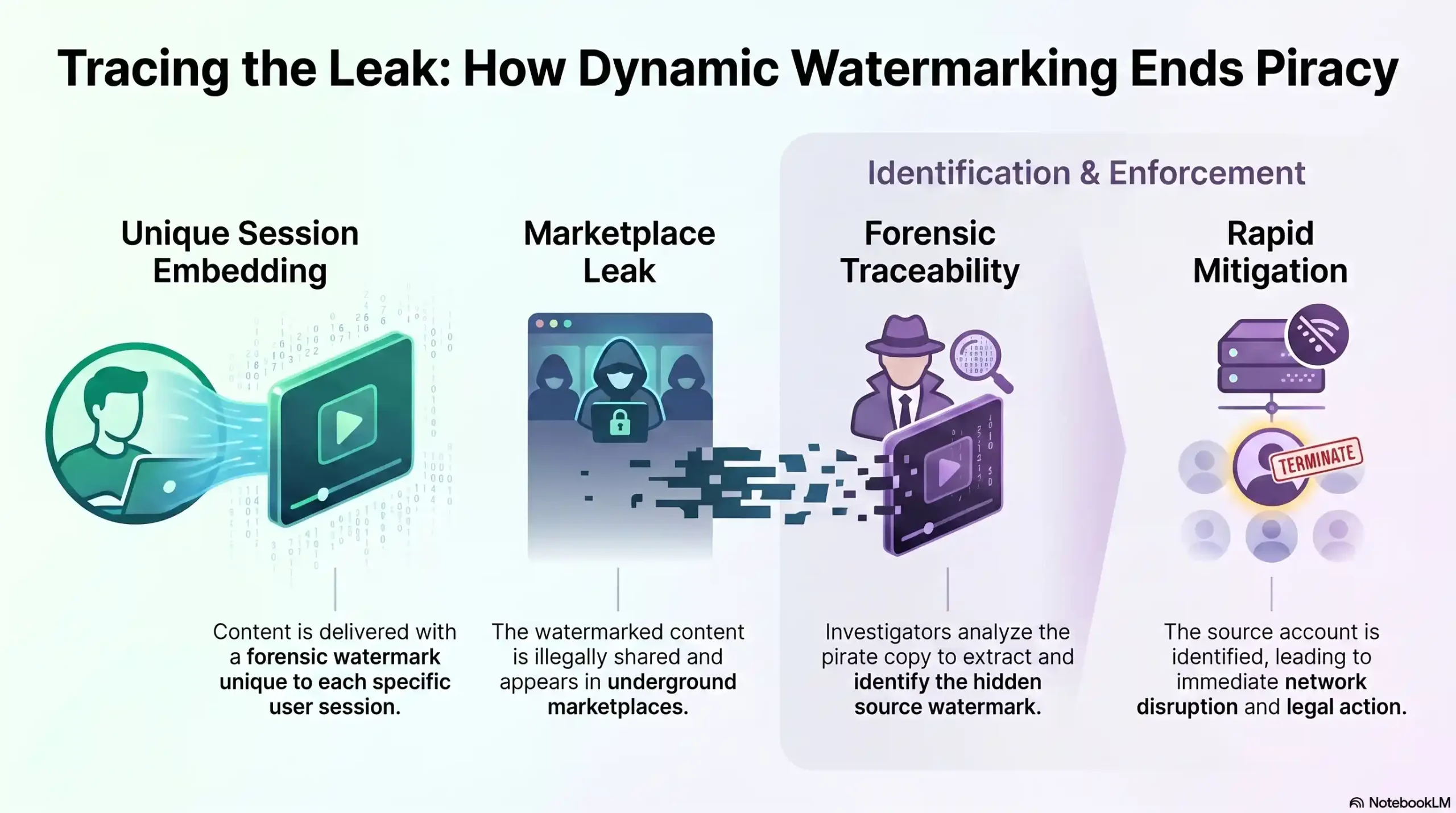
Content Delivery
- Action: Unique watermark embedded per session
- Outcome: Every view carries forensic identity
Piracy Detection
- Action: Content found in underground marketplace
- Outcome: Watermark survives re-encoding
Forensic Analysis
- Action: Watermark decoded by rights holder
- Outcome: Source account precisely identified
Enforcement Action
- Action: DMCA filing + account termination
- Outcome: Legal evidence chain established
Network Disruption
- Action: Piracy network avoids high-risk platform
- Outcome: Deterrence effect multiplies over time
7. What Every Creator and Platform Must Do Right Now
7.1 — The 5-Layer Protection Framework for Course Creators
Defeating course piracy networks requires a layered defense strategy that addresses every stage of the piracy supply chain. No single technology is sufficient. The following five-layer framework represents the minimum viable protection posture for any creator whose revenue depends on premium digital content.
Layer 1 — DRM Encryption at Source: Content must be encrypted at the encoding level using enterprise-grade DRM standards (Widevine, PlayReady, FairPlay) that prevent direct file extraction regardless of the delivery method.
Layer 2 — Dynamic Watermarking: Every viewing session must carry a unique, invisible forensic identifier that survives post-processing and enables source attribution when content is discovered in piracy networks.
Layer 3 — Credential Security: Multi-factor authentication, concurrent session limits, device fingerprinting, and anomalous access detection must be deployed to close the credential abuse vector.
Layer 4 — Real-Time Analytics & Threat Intelligence: Continuous monitoring of access patterns, geographic anomalies, and download behaviors must generate actionable alerts before content leakage occurs.
Layer 5 — Legal Enforcement Infrastructure: DMCA takedown capability, forensic evidence collection, and relationships with specialized IP enforcement services must be in place to act on intelligence gathered by Layers 1–4.
7.2 — Choosing the Right Platform: Questions You Must Ask
Not all video hosting and content protection platforms are equal in their ability to defend against the threat profile described in this article. Before entrusting your content to any platform, demand clear answers to these questions:
Does the platform use Widevine or equivalent enterprise DRM, or is it relying on JavaScript access control? Does it offer dynamic watermarking, or only static identifiers? Can it provide real-time concurrent session monitoring? What is its DMCA enforcement process and how quickly can it act on piracy reports? Does it offer forensic tracking that produces legally admissible evidence? Is the platform’s CDN infrastructure capable of delivering securely at global scale without performance compromises that incentivize users to seek content through alternative channels?
These questions separate platforms that provide genuine protection from those that provide the false security trap described in Section 5.
🔗 Local Resources & Citations
1. U.S. Copyright Office — Digital Millennium Copyright Act (DMCA) The official U.S. government resource for understanding your legal rights under the DMCA, including how to file a takedown notice when your course content is found on piracy platforms or unauthorized distribution channels.
2. WIPO — World Intellectual Property Organization | Copyright in the Digital Environment The United Nations agency governing global intellectual property law — use this resource to understand how international copyright treaties protect your digital course content across all 193 member states worldwide.
3. INTERPOL — Cybercrime Division The international law enforcement body coordinating cross-border cybercrime investigations across 196 countries — reference this page to understand how organized digital piracy networks are tracked, disrupted, and prosecuted at a global scale.
4. National Intellectual Property Rights Coordination Center — IPR Center (.gov) The U.S. Department of Homeland Security’s dedicated IP enforcement center — use this resource to report large-scale course piracy operations and access government-backed intelligence on how criminal IP theft networks are dismantled.
🔴 Inkrypt Videos Delivers All 5 Layers Under One Platform
From Widevine DRM encryption to dynamic watermarking to real-time analytics — Inkrypt Videos was built specifically to defeat the piracy networks described in this article. Setup takes under 30 minutes.
🌐 Visit: inkryptvideos.com
“Real security for real creators.”