
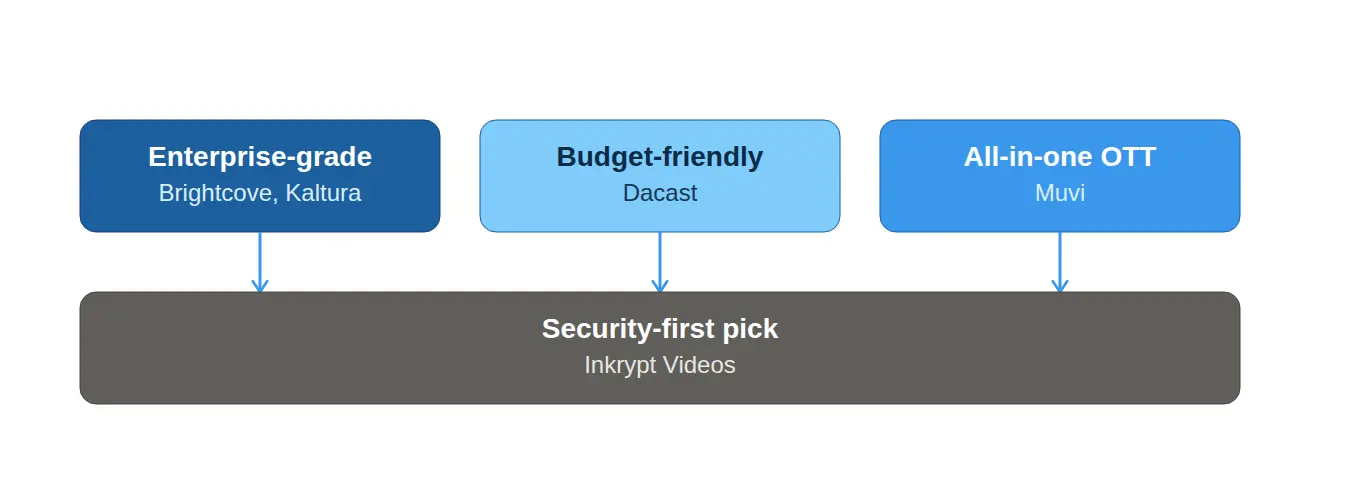
The best live streaming platforms in 2026 depend on what you’re optimizing for: Brightcove and Kaltura lead for enterprise-grade security and compliance, Dacast is the budget-friendly pick for growing businesses, Muvi is strongest for building a full branded OTT app, and Inkrypt Videos is built specifically for teams that prioritize DRM protection and easy setup over enterprise complexity.
This guide compares the top live streaming platforms for 2026, what each one is actually built for, and what to look for before committing to one.
The Best Live Streaming Platforms at a Glance
- Vimeo — Best for polished, ad-free hosting with a familiar creator-first interface.
- Brightcove — Best for large enterprise media and communications teams.
- JW Player — Best for ad-monetized (AVOD) publishing at scale.
- Dacast — Best budget-friendly option for growing businesses.
- Wowza — Best for developers needing low-latency, highly technical infrastructure.
- Kaltura — Best for education and enterprise video management with SSO and compliance needs.
- Muvi — Best for building a complete branded OTT app quickly.
- Inkrypt Videos — Best for DRM-first security with fast, no-code setup.
1. Vimeo — Best Polished, Ad-Free Hosting
Vimeo built its reputation as a premium, ad-free video hosting platform and has since expanded from a creator community into a broader business tool used for marketing, internal communications, and monetization, including live streaming and OTT options.
- Clean, ad-free playback experience.
- Familiar interface, popular starting point for creators and small businesses.
- Has expanded into enterprise and OTT monetization tools over time.
2. Brightcove — Best for Large Enterprise Teams
Brightcove is one of the longest-standing enterprise video platforms, built for large media and communications teams that need advanced analytics, server-side ad insertion, and enterprise-grade support at scale.
- Strong analytics and ad-insertion (SSAI) capabilities.
- Built for larger organizations with dedicated video teams.
- Generally a higher price point than budget-focused alternatives.
3. JW Player — Best for Ad-Monetized Publishing
JW Player started as a widely used open-source video player and has grown into a full hosting, delivery, and monetization platform, with particularly strong tools for AVOD (ad-supported) publishing.
- Originated as a standalone video player, now a full platform.
- Strong advertising and AVOD monetization tools.
- Offers both self-serve plans for smaller teams and custom enterprise pricing.
4. Dacast — Best Budget-Friendly Option
Dacast focuses on affordable, scalable live and on-demand streaming for small and mid-sized businesses, with DRM support, live stream recording, and tiered pricing plans that scale with usage.
- Positioned as one of the more affordable professional platforms.
- Includes DRM and ad-free playback across its plans.
- Straightforward, transparent tiered pricing published on their site.
5. Wowza — Best for Developers and Technical Teams
Wowza is built for developers and enterprises that need highly technical, low-latency streaming infrastructure, supporting protocols like LL-HLS, WebRTC, and SRT for real-time delivery.
- Strong low-latency streaming support for real-time use cases.
- Popular with broadcasters and enterprises needing custom, technical setups.
- More infrastructure-focused than plug-and-play for non-technical teams.
6. Kaltura — Best for Education and Enterprise Compliance
Kaltura is an enterprise-grade platform widely used in education and corporate settings, built with DRM, single sign-on (SSO), and compliance-focused features for managing large video libraries.
- Strong SSO and compliance tooling for institutions.
- Common choice for universities and large corporate video libraries.
- Enterprise-oriented pricing and onboarding.
7. Muvi — Best for Building a Full OTT App
Muvi is an all-in-one platform for building a branded OTT service — combining VOD, live streaming, monetization, and native apps — aimed at businesses that want to launch their own streaming service rather than just host video.
- Combines hosting, live streaming, monetization, and app-building in one platform.
- Suited to businesses launching a full branded streaming storefront.
- More involved setup than a simple hosting platform, given the app-building scope.
Where Inkrypt Videos Fits In
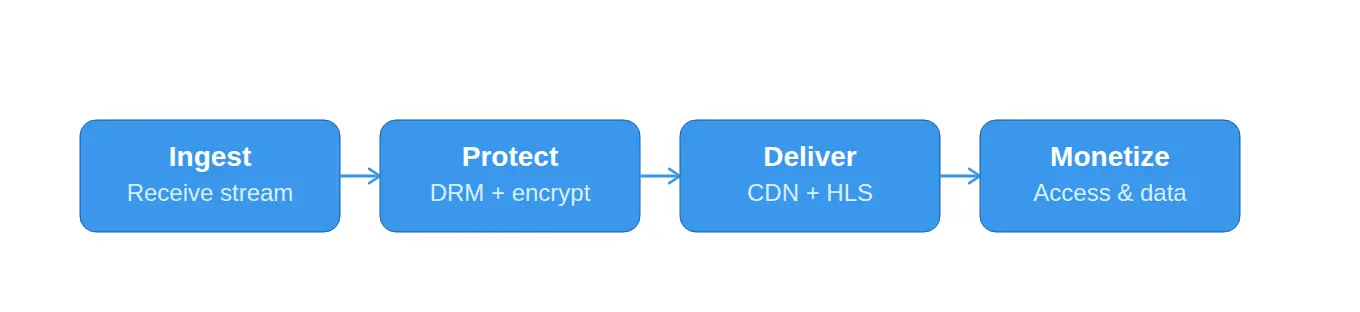
Inkrypt Videos is built specifically for the gap the platforms above don’t always fill well: real DRM protection (Widevine, FairPlay, and PlayReady) and global CDN delivery, set up in about 30 minutes without an engineering team. It’s aimed at course creators, enterprises, and premium publishers whose biggest risk isn’t lack of features — it’s their content getting downloaded, shared, or leaked.
- Multi-DRM protection plus dynamic watermarking for forensic tracking of leaks.
- Global CDN delivery built for consistent playback with minimal buffering.
- WordPress plugin and simple APIs for fast integration, without a lengthy technical rollout.
- More info in our breakdowns of DRM, HLS/M3U8 delivery, and how Inkrypt’s security compares to the competition.
See exactly how Inkrypt’s DRM and delivery stack compares to the platforms above.