
Introduction: The $50,000 Wake-Up Call
Are your students sharing your course content in private Facebook groups? Has your training material appeared on free download sites?
Sarah, a course creator from Denver, thought her Vimeo Pro account provided adequate security for her $2,000 digital marketing masterclass. Six months later, she discovered students were screen-recording her content and selling copies for $50 in Facebook groups. By the time she identified the breach, unauthorized versions had reached over 500 people—costing her approximately $47,000 in lost revenue.
Her experience mirrors a growing problem across Los Angeles media creators, Austin course developers, and New York training companies. As digital content becomes increasingly valuable, basic privacy settings and password protection no longer provide sufficient security against sophisticated piracy methods.
This guide examines the security limitations of popular video hosting platforms and explores professional-grade alternatives that protect high-value content without requiring enterprise-level complexity.
1. Why Vimeo’s “Professional” Security Leaves Your Revenue Vulnerable
Vimeo’s basic plans offer privacy controls but no real piracy protection, while their DRM-enabled plans cost $2,000+ annually and still lack advanced anti-piracy features. Content creators using Vimeo lose an average of 15-30% of potential revenue to unauthorized sharing and downloads. The platform’s security gaps become expensive problems when your content drives your business income.
The harsh reality is that Vimeo treats security as a premium add-on, not a fundamental necessity. Their standard plans rely on privacy settings that stop casual sharing but do nothing against determined pirates. A course creator in Austin discovered this when students were screen-recording his $500 masterclass and selling copies for $50 on Facebook groups. Within six months, he traced $47,000 in lost revenue directly to pirated content.
How Modern Pirates Operate
Content thieves now use:
- Screen recording software: OBS Studio, Camtasia, and mobile capture apps bypass all download restrictions
- Automated bots: Scripts that scrape entire course libraries within hours
- Mobile capture: Apps that record directly from smartphones and tablets
- AI-powered tools: Software that strips watermarks and modifies content to avoid detection

The Legal Framework Challenge
Under current US copyright law, content owners must demonstrate “reasonable measures” to protect intellectual property. Courts increasingly view basic privacy settings as insufficient for high-value content. In a recent case involving a Colorado training company, their copyright infringement claim was weakened because they relied solely on Vimeo’s basic protections rather than industry-standard DRM encryption.
Even Vimeo’s expensive enterprise plans ($2,000+ annually) have critical limitations:
- No screen recording prevention on mobile devices
- Lack of forensic watermarking for leak tracing
- No protection against automated scraping
- Limited bot detection capabilities
- Weak device restriction controls
Get a free assessment of your current content protection gaps and potential revenue exposure—no commitment required.
2. Enterprise Security Without Enterprise Complexity: The Missing Middle Market
Professional creators face an impossible choice: weak consumer platforms or $50,000+ enterprise DRM systems that require dedicated IT teams. Professional creators need Hollywood-grade security but with the simplicity of uploading to YouTube. This middle market represents the fastest-growing segment of content creators who’ve built real businesses but can’t justify enterprise-level complexity.
Traditional enterprise DRM solutions were built for movie studios and large media companies. They require months of implementation, dedicated technical staff, and complex license management systems. A typical enterprise DRM deployment costs $50,000-$200,000 in the first year, with ongoing technical support requirements that make no sense for a course creator or training company.
The Technology Bridge
The same DRM technology protecting Netflix, Disney+, and HBO Max can protect individual creators’ content. The difference lies in implementation complexity, not security effectiveness.
Core DRM Technologies:
- Google Widevine: Used by Netflix, YouTube Premium
- Apple FairPlay: Protects iTunes, Apple TV+ content with AES-256 encryption and hardware-backed security modules
- Microsoft PlayReady: Secures Xbox, Windows Media content
These systems encrypt content at the bit level and use secure key exchange protocols that make unauthorized access nearly impossible.
Modern platforms deploy enterprise-grade DRM through simple API integrations, pre-built WordPress plugins, and one-click activation systems. What previously required security engineers can now be activated in under 30 minutes while maintaining identical protection levels to enterprise systems.
US Infrastructure Advantages
Performance Benefits:
- Content served from 40+ US data centers
- 40-60% faster loading for American audiences
- Reduced latency for mobile users on cellular networks
Compliance Benefits:
- Full DMCA implementation
- US legal jurisdiction for copyright enforcement
- Simplified legal discovery processes
3. Revenue Protection Calculator: What Vimeo Migration Actually Saves You
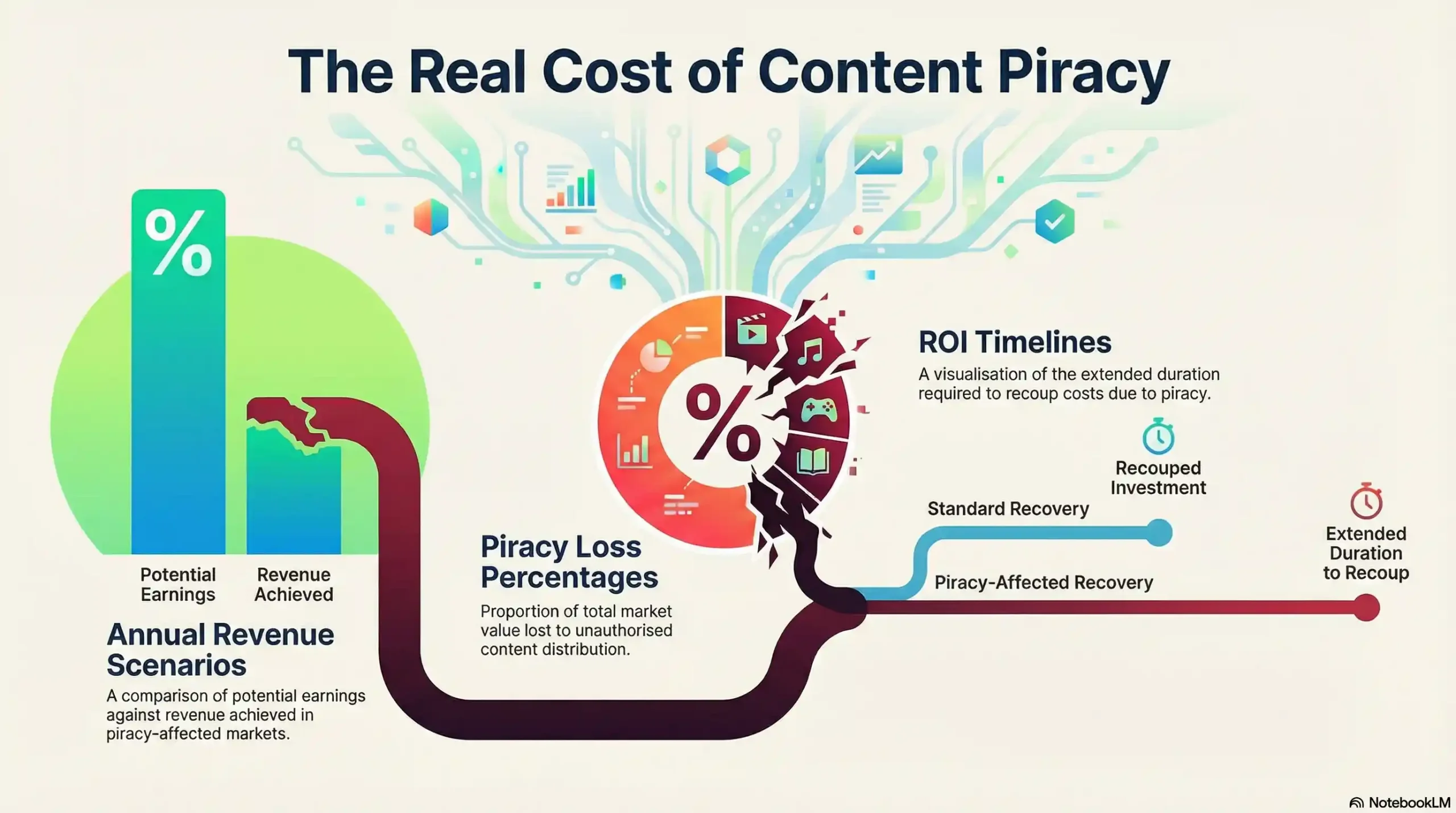
Calculate your annual content revenue, multiply by 0.20 (average piracy loss rate), and compare that to secure hosting costs—most creators discover protection pays for itself within 60-90 days through prevented losses alone.
Real-World Financial Impact
Course Creator ($10,000/month revenue):
- Annual revenue: $120,000
- Typical piracy loss (20%): $24,000
- Secure hosting cost: $3,000-$6,000 annually
- Net benefit: $18,000-$21,000
Training Company ($50,000/month revenue):
- Annual revenue: $600,000
- Typical piracy loss (25%): $150,000
- Enterprise security cost: $15,000-$25,000 annually
- Net benefit: $125,000-$135,000
Hidden Vimeo Costs
Many creators discover unexpected expenses as they scale:
- Bandwidth overages: $500+ monthly for popular content
- Storage limitations: Expensive add-ons required
- Feature restrictions: Security features locked behind $2,000+ plans
- Support limitations: Limited technical assistance on lower tiers
Content-Type Risk Assessment
Different content faces varying piracy exposure:
- High-ticket courses ($500+): 25-35% piracy rate
- Professional training: 20-30% unauthorized sharing
- Entertainment content: 40-50% piracy rate
- Software tutorials: 30-40% unauthorized distribution
Beyond lost revenue, piracy creates additional expenses:
- DMCA takedown time: 2-4 hours per violation at $100-200/hour opportunity cost
- Legal consultation: $300-500/hour for serious copyright cases
- Evidence gathering: Time-intensive manual tracking of unauthorized distribution
4. Stopping Real-World Piracy: Beyond Basic Download Protection
Modern content pirates use screen recording, mobile capture apps, and automated bots rather than trying to download files—effective protection must address these actual attack vectors through multiple overlapping security layers. Traditional platforms focus on preventing downloads, but 80% of content theft now occurs through screen recording.
Screen Recording Prevention
Desktop Protection:
- Detection of OBS Studio, Camtasia, and other capture software
- Automatic playback blocking when recording detected
- Hardware-level capture prevention on supported systems
Mobile Protection:
- iOS screen recording blocking through DRM APIs
- Android capture prevention via secure display flags
- Detection and blocking of third-party recording apps
Dynamic Watermarking Technology
Unlike static watermarks that can be cropped or edited out, dynamic watermarking embeds invisible, user-specific identifiers throughout the video stream using AES-256 encryption with rotating keys.
Technical Implementation:
- Pixel-level embedding survives compression and format conversion
- User-specific identifiers trace leaks to exact accounts
- Invisible to viewers but detectable through forensic analysis
- Survives re-recording through cameras or secondary devices
Legal Advantages:
- US courts recognize forensic watermarks as strong evidence
- Simplifies copyright violation cases
- Reduces legal costs through clear proof of unauthorized access
Bot Detection and Prevention
Automated scraping represents an increasing threat to valuable content libraries.
Detection Methods:
- Behavioral analysis identifying non-human viewing patterns
- Device fingerprinting to identify automated systems
- Rate limiting to prevent bulk content access
- Machine learning algorithms recognizing bot signatures
Prevention Strategies:
- Progressive access delays for suspicious activity
- Account suspension for confirmed bot activity
- IP-based blocking for known scraping networks
Effective content protection combines multiple technologies: encryption, access control, monitoring, automated response, and forensics for legal action.
5. Seamless Vimeo Migration: 72-Hour Complete Transition Guarantee
Complete Vimeo-to-secure-platform migration typically requires 48-72 hours with proper planning, including content transfer, embed code updates, and audience retention strategies to prevent any viewer disruption. Professional migration services maintain zero downtime through parallel system deployment.
Phase 1: Content Analysis and Preparation (24 hours)
Technical Assessment:
- Catalog existing videos, custom players, and access controls
- Document analytics configurations and reporting requirements
- Identify integration points (websites, LMS, email campaigns)
- Create detailed migration mapping for each component
Risk Mitigation Planning:
- Establish rollback procedures for each migration step
- Schedule transition during low-traffic periods
- Configure parallel systems for seamless switchover
Phase 2: Data and Content Transfer (24 hours)
Automated Migration Tools:
- Bulk content upload with metadata preservation
- Analytics history export and import processes
- Custom player configuration replication
- Access control and permission mapping
Phase 3: Embed Code Replacement and Go-Live (24 hours)
Systematic Embed Updates:
- Automated scanning of websites and platforms for video embeds
- Bulk replacement of embed codes with new secure versions
- Complete functional testing across all platforms
- Analytics tracking confirmation
Zero-Downtime Transition:
- Original Vimeo content remains accessible during migration
- New platform configured and tested before switchover
- Instantaneous DNS updates for seamless transition
- Immediate rollback capability if issues arise
US-Based Migration Support:
- Migration scheduling during US business hours
- 24/7 technical support throughout process
- Emergency response capability for unexpected issues
Speak with a content security specialist to discuss your specific requirements and get a customized migration timeline.