

YouTube is built for maximum visibility, but for businesses, that “openness” is a critical security vulnerability. To protect premium content from piracy and unauthorized sharing, you need a platform that replaces public links with Hollywood-grade DRM encryption and dynamic watermarking. This guide identifies the top secure YouTube alternatives for 2026 to help you migrate from “public-by-default” to enterprise-grade protection in under 30 minutes.
Why YouTube Fails as a Business Video Platform
The Security Gap: Public by Design
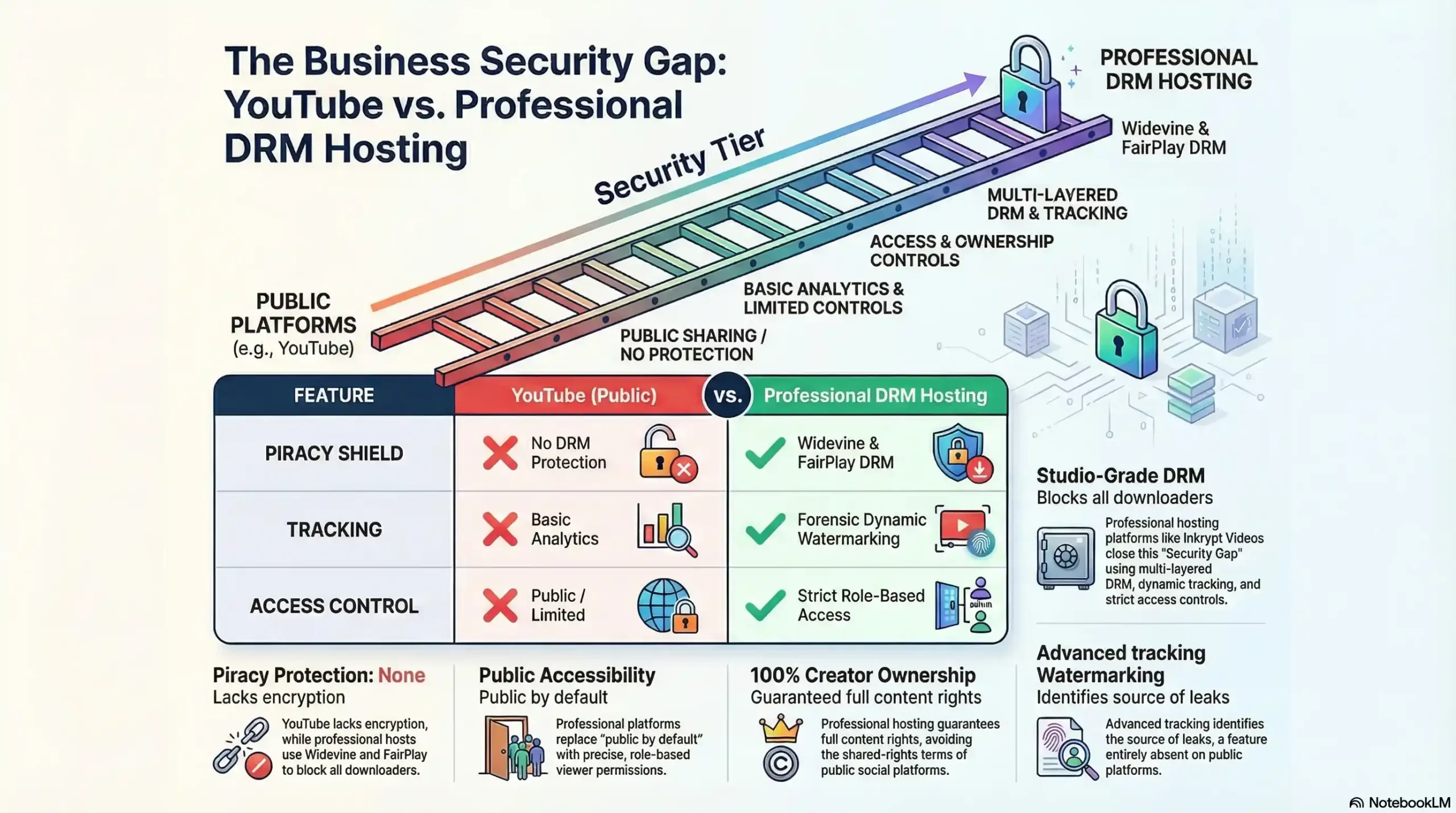
YouTube is public by default and offers limited security features that fall short of enterprise-level protocols. The platform’s fundamental architecture prioritizes broad accessibility over content protection, creating multiple vulnerabilities for business users.
“Unlisted” YouTube videos can still be discovered by anyone with the video link and may be indexed by search engines if previously listed as “Public.” This means sensitive corporate content remains vulnerable to accidental exposure and unauthorized sharing.
Content Ownership and Control Issues
When businesses upload videos to YouTube, they face significant ownership challenges. By uploading content, companies grant YouTube royalty-free and non-exclusive rights over their material, essentially forfeiting control.
Additionally, YouTube provides minimal control over:
- Video player customization and branding
- Viewer access management
- Content distribution restrictions
- Analytics data ownership
Compliance and Legal Risks
For businesses in regulated industries, YouTube creates compliance nightmares. Regulations such as GDPR, HIPAA, and PCI-DSS require encrypted data storage, yet YouTube’s infrastructure doesn’t provide the granular security controls necessary for regulatory compliance.
Data breaches, unauthorized access, intellectual property loss, and legal penalties represent just some of the risks businesses face with unsecured video hosting.
Essential Features of Secure YouTube Alternatives
Advanced Encryption and DRM Protection
Professional business video hosting platforms implement multiple layers of security. DRM (Digital Rights Management) encrypts content to prevent unauthorized access. Modern platforms utilize AES encryption, secure transmission protocols (HTTPS/SSL/TLS), and DRM with forensic watermarking.
Google Widevine & Apple FairPlay DRM ensure no downloader, plugin, or hack can download secure videos streamed through professional platforms. This level of protection is impossible with YouTube’s consumer-focused architecture.
Secure Your Content in 30 Minutes – Get a Free DRM Demo
Granular Access Controls
Enterprise video platforms provide sophisticated user management capabilities:
- Role-based permissions with granular viewing rights
- Domain restrictions and IP whitelisting
- Geographic blocking and time-based access controls
- Single Sign-On (SSO) integration with existing corporate systems
Dynamic Watermarking and Piracy Prevention
Dynamic watermarking discourages screen capture with user-based watermarks like IP address, user ID, email ID, or phone number. This forensic-level protection helps identify unauthorized sharing and provides legal recourse against content theft.
Comprehensive Analytics and Insights
Professional platforms offer detailed viewer analytics beyond YouTube’s basic metrics:
- Individual viewer tracking and engagement heatmaps
- Security event monitoring and breach detection
- ROI measurement and conversion tracking
- Compliance reporting and audit trails

Top Secure YouTube Alternatives for Businesses
1. VdoCipher – Maximum Security for Premium Content
VdoCipher provides the highest security from piracy with Google Widevine & Apple FairPlay DRM, offering total screen capture block and comprehensive security measures.
Key Features:
- Hollywood-grade DRM encryption
- Anti-screen recording technology
- Dynamic forensic watermarking
- Comprehensive analytics dashboard
Best For: Online course creators, media companies, and businesses with high-value digital content requiring maximum protection.
Pricing: Plans start at $129/year for starter plans. Free tier includes 5GB bandwidth and up to 4 videos for 30 days.
2. VIDIZMO EnterpriseTube – Corporate YouTube Alternative
VIDIZMO EnterpriseTube functions like a corporate YouTube where organizations can store and share videos securely, offering customizable access control and enterprise system integration.
Key Features:
- AI-powered video search and discovery
- Multi-portal architecture with separate security policies
- Comprehensive compliance support (GDPR, HIPAA, SOX)
- Advanced user management and authentication
Best For: Large enterprises, government agencies, and organizations requiring comprehensive video management solutions.
Pricing: Starts at $1,000/month for enterprise deployment, with custom pricing based on requirements.
3. Brightcove – Enterprise-Scale Video Platform
Brightcove specializes in enterprise-level video hosting and streaming solutions, known for secure video management and powerful analytics.
Key Features:
- Multi-DRM support (Widevine, PlayReady, FairPlay)
- Global CDN with optimized delivery
- Advanced analytics and audience insights
- Extensive API integration capabilities
Best For: Media companies, large corporations, and organizations requiring global-scale video delivery.
Pricing: Plans start at $199/month for Marketing Starter, with Enterprise plans from $99/month per user.
4. Wistia – Marketing-Focused Business Platform
Wistia emphasizes conversion tools, branding control, analytics, and lead capture, making it the marketer’s preferred choice for business video hosting.
Key Features:
- Lead generation and conversion tools
- Custom branding and player customization
- Detailed viewer analytics and engagement tracking
- Marketing automation integrations
Best For: Marketing teams, content-driven businesses, and organizations focused on video-driven lead generation.
Pricing: Free plan available. Paid plans range from $19/month (Plus) to $319/month (Advanced).
5. Gumlet – Performance-Optimized Secure Hosting
Gumlet is known for video optimization and delivery, increasingly used as a lightweight hosting solution for teams valuing performance, cost control, and seamless integration.
Key Features:
- AI-powered video optimization
- DRM protection and security controls
- Global CDN with intelligent optimization
- Cost-effective pricing model
Best For: Small to medium businesses requiring high-performance video delivery with security features.
Pricing: Free plan with 100 storage minutes. Paid plans from $10/month (Starter) to $199/month (Business).
Implementation Best Practices
Technical Integration
Modern enterprises require seamless integration capabilities:
- Learning Management Systems (LMS): For training and educational content
- Customer Relationship Management (CRM): For sales and marketing videos
- Content Management Systems (CMS): For web-based video deployment
- Single Sign-On (SSO): For unified authentication across platforms
Compliance and Governance
Ensure your chosen platform provides:
- Data residency controls for regional compliance
- Audit trails for regulatory reporting
- Privacy controls for data protection laws
- Retention policies for content lifecycle management
Cost Considerations: ROI of Secure Video Hosting
Hidden Costs of “Free” Platforms
While YouTube appears free, businesses face high hidden costs:
- Security Breach Recovery: Data recovery and migration costs
- Lost Intellectual Property: Revenue loss from unauthorized content distribution
- Compliance Violations: Legal and regulatory penalties
- Brand Damage: Reputation costs from security incidents
Investment in Professional Platforms
For small volumes, businesses typically pay $10–$200/month for professional video hosting. Large-scale enterprise use ranges from hundreds to thousands monthly, but this investment provides:
- Risk Mitigation: Protection against costly security breaches
- Productivity Gains: Streamlined video management and distribution
- Revenue Protection: Prevention of content piracy
- Competitive Advantage: Professional presentation and enhanced viewer experience
Future Trends in Secure Business Video Hosting
AI-Enhanced Security Features
Future platforms will leverage artificial intelligence for:
- Automated threat detection and response
- Content analysis for compliance monitoring
- Predictive analytics for security risk assessment
- Intelligent access management based on user behavior
Zero-Trust Architecture
Zero-trust access control via tokenized/expiring links and strict compliance with global privacy regulations like GDPR and CCPA represent the future of enterprise video security.
Making the Switch: Migration Strategies
Assessment and Planning
Before migrating from YouTube:
- Content Audit: Catalog existing video assets and classify by security requirements
- User Analysis: Identify stakeholder needs and access patterns
- Integration Requirements: Map necessary connections with existing business systems
- Compliance Assessment: Evaluate regulatory requirements for your industry
Implementation Phases
Phase 1: Pilot Program
- Select a subset of content for initial migration
- Test security features and user experience
- Gather feedback from key stakeholders
Phase 2: Gradual Migration
- Migrate content in batches based on priority
- Update existing links and integrations
- Train users on new platform features
Phase 3: Full Deployment
- Complete content migration
- Implement comprehensive security policies
- Establish ongoing monitoring procedures
Resources & Citations
1. Private Video Hosting Platforms Market Research
Strategic Revenue Insights Market Report (2025)
Private Video Hosting Platforms Market Size, Future Growth, and Forecast 2033
2. Enterprise Video Content Management Analysis
Gartner Research on Enterprise Video Platforms (2025)
Enterprise Video Content Management Market Analysis
3. Digital Rights Management and Video Security Standards
VdoCipher Video Security Technology Documentation (2025)
Secure Video Hosting for Business – DRM Protection Standards
Conclusion
The decision to move beyond YouTube for business video hosting represents taking control of digital assets and protecting organizational futures. The private video hosting platform market, valued at $1.75 billion in 2025 and projected to reach $4.2 billion by 2033, demonstrates growing recognition that businesses need professional-grade video solutions.
Whether you’re protecting premium educational content, managing sensitive corporate communications, or distributing valuable intellectual property, secure video hosting platforms provide protection, control, and professional capabilities that YouTube cannot offer.
Investment in a secure YouTube alternative pays dividends through enhanced security, regulatory compliance, and protection of valuable digital assets. As cyber threats evolve and regulations become more stringent, the question isn’t whether to upgrade video hosting—it’s how quickly you can implement solutions that truly protect business interests.
Start by evaluating current video security needs, assessing the platforms outlined in this guide, and taking the first step toward truly secure business video hosting. Your content—and your business—deserves professional-grade protection.