
Film piracy is the unauthorized copying, distribution, or public exhibition of copyrighted movies — everything from a phone recording a theater screen to a leaked pre-release copy circulating online. It costs the film industry billions of dollars a year, and understanding how it actually happens is the first step to protecting content against it.
This guide covers what counts as film piracy, how it typically happens (at a level useful for content owners, not a how-to), what it costs the industry, and how studios and platforms fight back.
What Is Film Piracy?
Film piracy is any unauthorized copying, distribution, or public presentation of a copyrighted film — a definition broad enough to cover a cinema recording, a leaked screener, an illegal streaming site, or a pirated download shared in a private chat group. It’s a copyright violation regardless of whether money changes hands; distributing a film for free without authorization is still piracy.
How Do Movies Get Pirated? (Common Methods)
Film piracy usually starts with a single point of failure in a long distribution chain, not a dramatic hack — a leaked screener, a shared password, or a phone pointed at a theater screen — and spreads fast once that first copy exists. In broad terms, the common paths are:

- In-theater recording — Cam and telesync recordings captured during a screening, still one of the oldest and most persistent piracy methods.
- Screener and insider leaks — Pre-release copies intended for critics, distributors, or production staff finding their way outside authorized hands.
- Credential sharing — Login details for streaming services shared or sold beyond their intended use.
- Stream ripping and protection circumvention — Tools that capture or extract video from a legitimate stream or protected file.
- Redistribution at scale — Once a copy exists, it spreads through torrent networks, illegal streaming sites, and messaging apps far faster than it can be taken down.
We’ve published a deeper breakdown of these methods in How Is Movie Piracy Done? if you want the full mechanics behind each one.
The Real Cost of Film Piracy
Film piracy’s cost is measured in billions of dollars a year, though the exact figure depends on which study and year you’re looking at. The most frequently cited figure comes from the Motion Picture Association (MPA), which reported that in 2020, an estimated 137.2 billion visits went to film and TV piracy sites globally, costing the U.S. economy at least $29.2 billion in lost revenue annually and reducing industry employment by an estimated 230,000 to 560,000 jobs. More recent industry estimates put global piracy losses across all media well above that figure, though methodologies vary significantly between studies — worth keeping in mind when you see a specific number cited as fact.
Beyond the direct revenue loss, piracy sites carry their own risk to viewers: independent research has repeatedly found a meaningful share of piracy sites serving malware through their ads, adding a security dimension on top of the financial one.
Is Film Piracy Illegal?
Yes — film piracy is a copyright violation, and in the U.S., circumventing the technical protections used to prevent it (like DRM) is a separate, additional violation under the DMCA’s Section 1201, regardless of whether the underlying content was actually copied. Enforcement and penalties vary by country, which is part of why piracy remains a persistent, global problem rather than one any single jurisdiction can fully solve.
How the Film Industry Fights Piracy
The film industry’s response to piracy layers three approaches together, since no single method catches everything on its own:
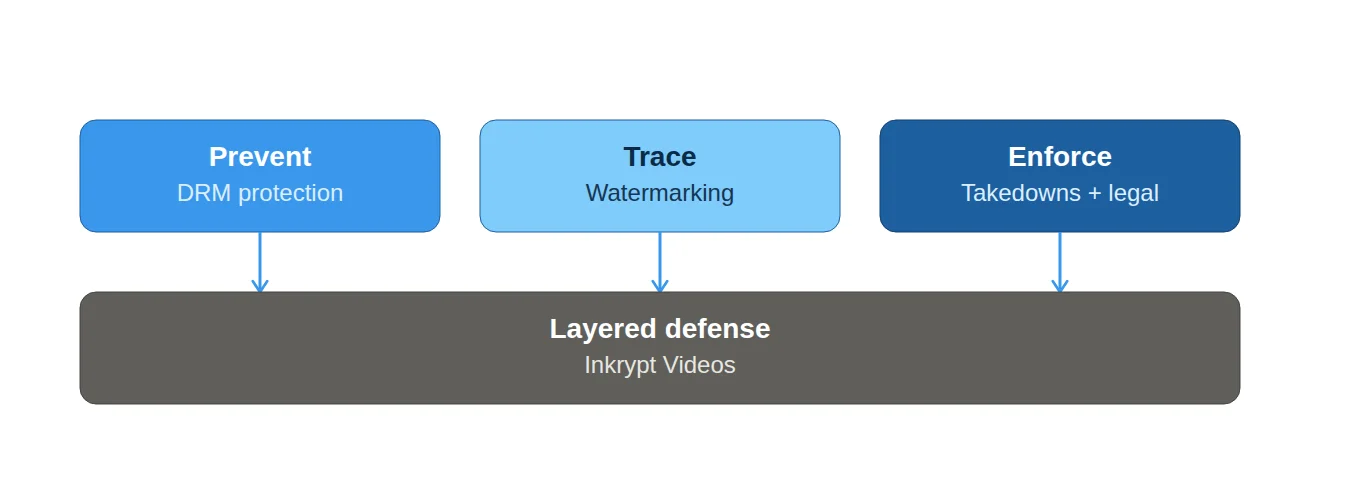
- Prevention — DRM encryption controls who can decrypt and play protected content in the first place, the same technology we cover in What Is DRM?
- Traceability — Forensic and dynamic watermarking embeds identifying information into a video, so if a leak does happen, its source can often be traced.
- Enforcement — Industry coalitions like the Alliance for Creativity and Entertainment (ACE) coordinate takedown requests and legal action against large-scale piracy operations globally.
Where Inkrypt Fits In
Inkrypt Videos builds the first two layers of that defense directly into video hosting — multi-DRM protection (Widevine, FairPlay, PlayReady) to prevent unauthorized access, and dynamic watermarking to trace leaks back to their source. For studios, premium publishers, and course creators alike, that combination covers the piracy risk that basic password protection or access gating simply doesn’t. See our content protection features for the full picture.