Table of Contents
ToggleAES (Advanced Encryption Standard) video encryption scrambles your video into unreadable ciphertext that only authorized players can unlock with a secret digital key. It protects streams by making intercepted data useless to pirates and hackers, stopping man-in-the-middle attacks, and forming the foundation of secure streaming protocols like HLS. AES is necessary protection — but only when paired with secure key delivery and DRM is it truly unbreakable.
Most “secure” video isn’t. Creators and media companies pay for protection, see a padlock in the browser, and assume their premium content is locked down. Then a finished course or a pay-per-view event shows up on a piracy site within hours. The uncomfortable truth is that a lot of streaming security is cosmetic — it protects the connection but leaves the content exposed. AES video encryption is where real protection begins, and understanding it is the difference between content that’s genuinely safe and content that only feels safe.
What Is AES Video Encryption?
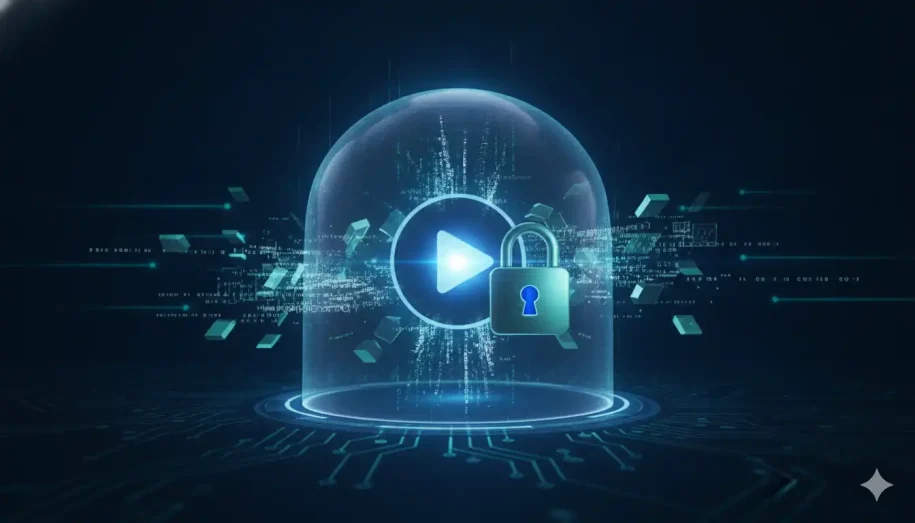
AES video encryption is the process of encoding your video so that it becomes unreadable scrambled data — called ciphertext — to anyone without the correct decryption key.
The Plain-English Definition
Think of your video as a message locked inside a vault. AES is the lock, and the encryption key is the only key that opens it. When you encrypt a video with AES, its raw data is run through a symmetric-key algorithm that transforms it into meaningless noise. The same key both locks (encrypts) and unlocks (decrypts) the content — that’s what “symmetric” means. Without that key, an attacker who steals your video file gets nothing but a useless jumble of bytes. With it, an authorized video player decrypts the stream in real time, and your viewer watches normally, never aware that any of this happened.
Why “Military-Grade” Actually Means Something Here
The phrase “military-grade” gets thrown around loosely, but with AES it’s earned. The Advanced Encryption Standard was established by the U.S. National Institute of Standards and Technology (NIST) in 2001 and is the algorithm approved to protect government-classified information. It’s a block cipher that processes data in fixed 16-byte blocks through multiple rounds of substitution and permutation, specifically engineered to resist cryptanalytic attacks while staying fast enough for real-time video. When a platform tells you it uses AES, it’s using the same cryptographic standard that governments trust with secrets. That’s not marketing — it’s the global baseline for serious content protection.
How AES Encryption Actually Protects a Video Stream
Encryption is invisible to your viewers, but behind the scenes it’s doing constant work to keep your content out of the wrong hands.
The Encryption-to-Playback Journey
When you upload a video to a secure platform, the file is encrypted into ciphertext before it’s ever stored or delivered. As a viewer presses play, the encrypted segments travel across the internet still scrambled. Only the authorized player — running on a device that has legitimately obtained the key — decrypts those segments on the fly and renders them as watchable video. At no point does an unprotected, plain copy of your file sit exposed on a public network. If someone intercepts the stream mid-delivery, all they capture is encrypted noise.
Stopping Man-in-the-Middle Attacks on Public Networks
This matters most on the open internet, where man-in-the-middle (MITM) attacks are a constant threat. In a MITM attack, a hacker positions themselves between your viewer and your server — often on unsecured public WiFi — and uses packet sniffers to intercept the data flowing between them. Without encryption, that intercepted stream is fully readable and easily stolen. With AES encryption working alongside TLS/HTTPS, the captured data is cryptographically worthless. The attacker sees ciphertext they can’t decode, and your content — and your revenue — stays protected. This is exactly why platforms like Netflix and major learning platforms encrypt every stream they deliver.
➡️ See exactly how Inkrypt encrypts your streams from upload to playback.
AES-128 vs. AES-256: Which Does Your Stream Need?
One of the most common questions creators ask is whether they need AES-128 or AES-256. The answer is more reassuring than most expect.
Why HLS Streaming Runs on AES-128
The dominant streaming protocol, HTTP Live Streaming (HLS), natively encrypts video using AES-128. So do the major DRM systems. This is by design: AES-128 delivers an exceptional balance of ironclad security and computational efficiency, allowing real-time encryption and decryption even on older or lower-powered devices. Because virtually every modern browser and device supports it, AES-128 is the workhorse of secure video streaming worldwide. If your platform uses HLS, AES-128 is almost certainly doing the heavy lifting — and that’s a feature, not a compromise.
The Bit-Count Myth
It’s tempting to assume AES-256 is “twice as safe” as AES-128 because the key length is double. In practice, that’s not how it works. AES-128 is already computationally infeasible to break by brute force — even a supercomputer working for billions of years wouldn’t crack it without the key. AES-256 offers a higher theoretical margin and is excellent for archival or ultra-sensitive content, but for video streaming it doesn’t meaningfully change your real-world risk. The danger to your content was never someone brute-forcing the cipher. The danger is how the key is handled — which is exactly where most “secure” streaming quietly falls apart.
The Hidden Weak Link: Key Delivery
Here’s the part the saturated SERP rarely explains clearly, and it’s the single most important thing you’ll read in this article: AES encryption is only as strong as the way the key is delivered.
How “Encrypted” Streams Still Get Ripped
In HLS, your video is split into segments, and a playlist file called the M3U8 manifest tells the player where to find them. That manifest also references the encryption key, typically via an EXT-X-KEY tag pointing to the key’s location. If that key is served carelessly — over plain HTTP, without authentication, sitting in the same place anyone can reach — then a tech-savvy pirate simply grabs the key from the manifest, downloads the encrypted segments, and decrypts the whole video themselves. The content was “encrypted” the entire time. It still got stolen. This is precisely the false confidence that costs creators their revenue.
What Real Key Protection Looks Like
Genuine protection treats the key as the crown jewel. That means serving the key only over HTTPS, gating it behind token authentication so only verified, logged-in viewers can request it, and using signed URLs that expire quickly and can’t be shared. It means storing keys in separate, secured infrastructure rather than alongside the video files. And for high-value or live content, it means key rotation — issuing fresh per-session keys at regular intervals so that even a leaked key unlocks only a tiny, expired slice of the stream. When key delivery is done right, stealing one piece gets an attacker nowhere.
➡️ Not sure if your current setup leaks its keys?
AES vs. DRM: Why Encryption Alone Isn’t Enough
If AES is so strong, why do studios and streaming giants insist on more? Because encryption and Digital Rights Management (DRM) solve two different problems.
AES Protects the File — DRM Decides Who Watches
AES scrambles your content so it can’t be read without the key. DRM sits on top of that encryption and governs the rules: who is allowed to decrypt, on which devices, for how long, and under what conditions. AES protects the file; DRM enforces the policy. The major DRM systems — Widevine (Google), FairPlay (Apple), and PlayReady (Microsoft) — all use AES under the hood but add license management, device validation, and playback controls. Because each covers different devices, premium platforms deploy all three in a multi-DRM setup: encrypt once, distribute everywhere, and reach every viewer securely.
The Complete Protection Stack
Think of real stream protection as four layers working together. First, AES encryption scrambles the content. Second, secure key delivery ensures only authorized viewers ever receive the key. Third, DRM enforces granular rights AES can’t — blocking screen recording, offline ripping, and unauthorized playback on jailbroken devices. Fourth, dynamic watermarking embeds traceable, viewer-specific marks so that if content does leak, you can identify the source. AES is the foundation of this fortress — but a foundation alone isn’t a building.
For a deeper look at how encryption fits into the full delivery stack — including CDN infrastructure and tokenized URLs — see our guide to video stream encryption.
How to Choose a Video Platform That Encrypts Correctly
Knowing the technology is only useful if you can tell whether a vendor actually implements it properly. Use this as your buying checklist.
The 5-Point Encryption Checklist
A platform worth trusting with your content should deliver, at minimum: file-level AES encryption (not just an HTTPS connection); secure key delivery with token authentication, signed URLs, and key rotation; DRM-readiness with multi-DRM support across Widevine, FairPlay, and PlayReady; dynamic watermarking for forensic traceability; and detailed analytics so you can monitor access and spot threats. If a provider checks all five, your content is genuinely protected — not just decorated with a padlock.
Red Flags That Signal False Confidence
Be wary of any platform that markets “secure streaming” but only encrypts the connection, won’t explain how it delivers and protects keys, treats DRM as an afterthought, or offers no way to trace a leak back to its source. Vague reassurance is the hallmark of cosmetic security. Real security partners can show you exactly how each layer works — because they have nothing to hide and everything to prove.
➡️ Stop settling for protection that only looks secure. Lock down your streams with real, end-to-end content protection — start your free trial.
Conclusion: Real Security for Real Creators
AES video encryption is the bedrock of protecting your streams — proven, government-grade, and fast enough to secure every viewer in real time. But encryption is the foundation, not the finish line. The streams that actually stay safe are the ones where strong AES is paired with airtight key delivery, enforced by DRM, and traceable through watermarking. That’s the difference between content that feels protected and content that genuinely is. Your work is too valuable to defend with false confidence. Demand real security — the kind that holds up when pirates come knocking.
Resources & Citations
- NIST — FIPS 197, Advanced Encryption Standard: The official U.S. government standard defining AES — confirm here that “military-grade” is a verifiable fact, not marketing.
- Apple Developer — HTTP Live Streaming (HLS): Apple’s official HLS documentation showing how AES-128 segment encryption and FairPlay operate in real streaming.
- Google Widevine DRM: The official technical overview of Widevine, the most widely deployed DRM system, validating the AES-plus-DRM stack.
- Microsoft PlayReady: Microsoft’s official PlayReady documentation, completing the multi-DRM technical reference set.
Frequently Asked Questions
Yes. AES-128 is secure enough for virtually all video streaming. It’s computationally infeasible to brute-force — even a supercomputer couldn’t crack it without the key in any practical timeframe. It’s also the encryption standard HLS uses natively, which is why major streaming platforms rely on it.
Yes, if the encryption key is poorly protected. AES scrambles your video perfectly, but if the key is delivered over plain HTTP or left unsecured in the manifest file, a pirate can grab it and decrypt the content. Real protection depends on secure key delivery, not just the cipher.
AES encryption scrambles your video so it can’t be read without a key, while DRM (Digital Rights Management) controls who is allowed to decrypt it and how. AES protects the file; DRM enforces the rules — like blocking screen recording, device sharing, and unauthorized playback.
No. AES is designed to be computationally efficient, so it encrypts and decrypts video in real time without noticeable lag — even on older or lower-powered devices. Viewers experience smooth playback while the encryption works invisibly in the background.
For video streaming, AES-128 is fine. AES-256 offers a higher theoretical security margin and suits archival or ultra-sensitive content, but it isn’t “twice as safe.” Since HLS uses AES-128 natively and 128-bit keys are already unbreakable in practice, the bit count rarely changes your real-world risk.
Check whether it encrypts the file itself, not just the connection. A genuinely secure platform offers file-level AES encryption, secure key delivery with token authentication, DRM support, and dynamic watermarking. If a provider only mentions an HTTPS padlock, your content may only feel protected.
No. HTTPS encrypts the connection between the viewer and the server, but it doesn’t protect the video file itself. Once the stream arrives, an HTTPS-only video can still be downloaded and shared. True video security requires AES encryption applied to the content, layered on top of HTTPS.
AES stands for Advanced Encryption Standard, a symmetric block cipher established by the U.S. National Institute of Standards and Technology (NIST) in 2001 to protect classified government data.
HTTP Live Streaming (HLS) is the most common protocol using AES-128 encryption. The major DRM systems — Widevine, FairPlay, and PlayReady — also rely on AES as their underlying encryption algorithm.
Key rotation issues fresh encryption keys at regular intervals during a stream. If one key is ever leaked, it only unlocks a small, expired segment of video rather than the entire file — sharply limiting the damage from any single breach.
Yes. AES encrypts live streams in real time, scrambling each segment as it’s delivered. For live content, per-session keys and frequent key rotation are recommended to maximize security during broadcast.
Encryption supports GDPR and HIPAA compliance by protecting sensitive video data from unauthorized access. While encryption alone doesn’t guarantee full compliance, it’s a core safeguard for meeting data-protection requirements when handling personal or regulated content.
This article is for general informational purposes only and does not constitute security or legal advice. Encryption requirements vary by use case; consult a qualified professional before making content-protection decisions.