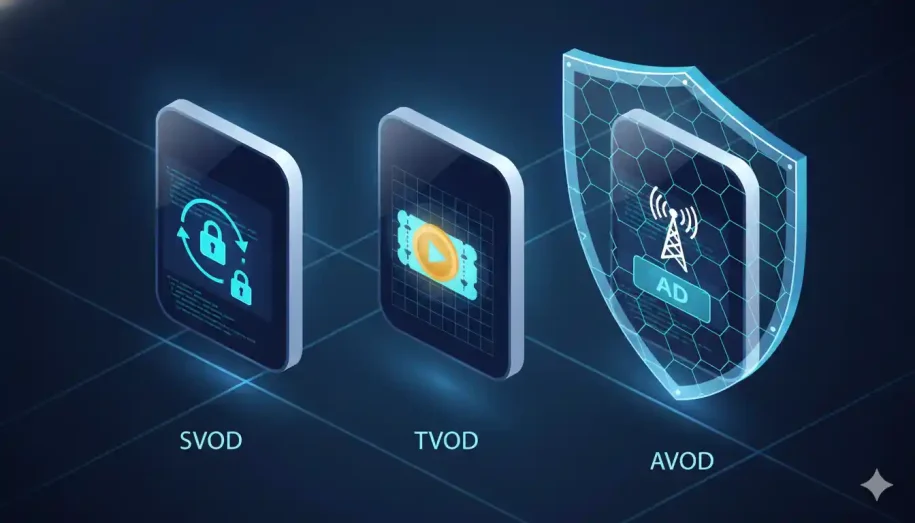
SVOD (Subscription Video on Demand), TVOD (Transactional Video on Demand), and AVOD (Advertising Video on Demand) are the three dominant video monetization models used by streaming platforms today. SVOD charges a recurring subscription fee for unlimited access. TVOD charges per title or event. AVOD offers free content funded by advertising revenue. Each model carries distinct implications for revenue predictability, audience reach, and — critically — content security. Choosing the wrong model without the right protection layer can expose your content to piracy and revenue loss.
What Is Video Monetization and Why Your Model Choice Matters
Building a video platform is only half the battle. The harder question — the one that determines whether your platform survives its first year — is how you get paid for what you create.
Video monetization is the strategic framework that converts your content library into a sustainable revenue stream. It is not a technical decision. It is a business-defining one. The model you choose will shape your pricing, your audience expectations, your cash flow, and — in ways most creators never consider until it is too late — your exposure to content theft and piracy.
In 2026, the global OTT market is projected to surpass 860 million viewers. Yet the platforms that fail are rarely the ones with bad content. They are the ones that chose a monetization model misaligned with their audience, their content type, or their security infrastructure.
For the full picture across all six video revenue models, including licensing and freemium, see our guide to monetizing online video.
The Real Cost of Choosing the Wrong Model
A course creator who launches on an AVOD model — giving away content in exchange for ad revenue — quickly discovers that their premium intellectual property is now freely accessible, easily screen-recorded, and circulating on piracy forums within weeks. A live event producer who relies on SVOD subscriptions for a one-time premium event leaves enormous per-view revenue on the table.
The mismatch between model and content type does not just cost money — it actively devalues what you have spent months or years building.
How Monetization Models Affect Content Security
Here is the dimension that most comparison guides ignore entirely: each monetization model carries a different piracy risk profile. SVOD platforms face credential sharing. TVOD platforms face post-purchase redistribution. AVOD platforms — despite offering free content — face stream ripping and unauthorized rehosting. Understanding these risks before you choose your model is not optional. It is the difference between a platform that scales and one that bleeds revenue invisibly.
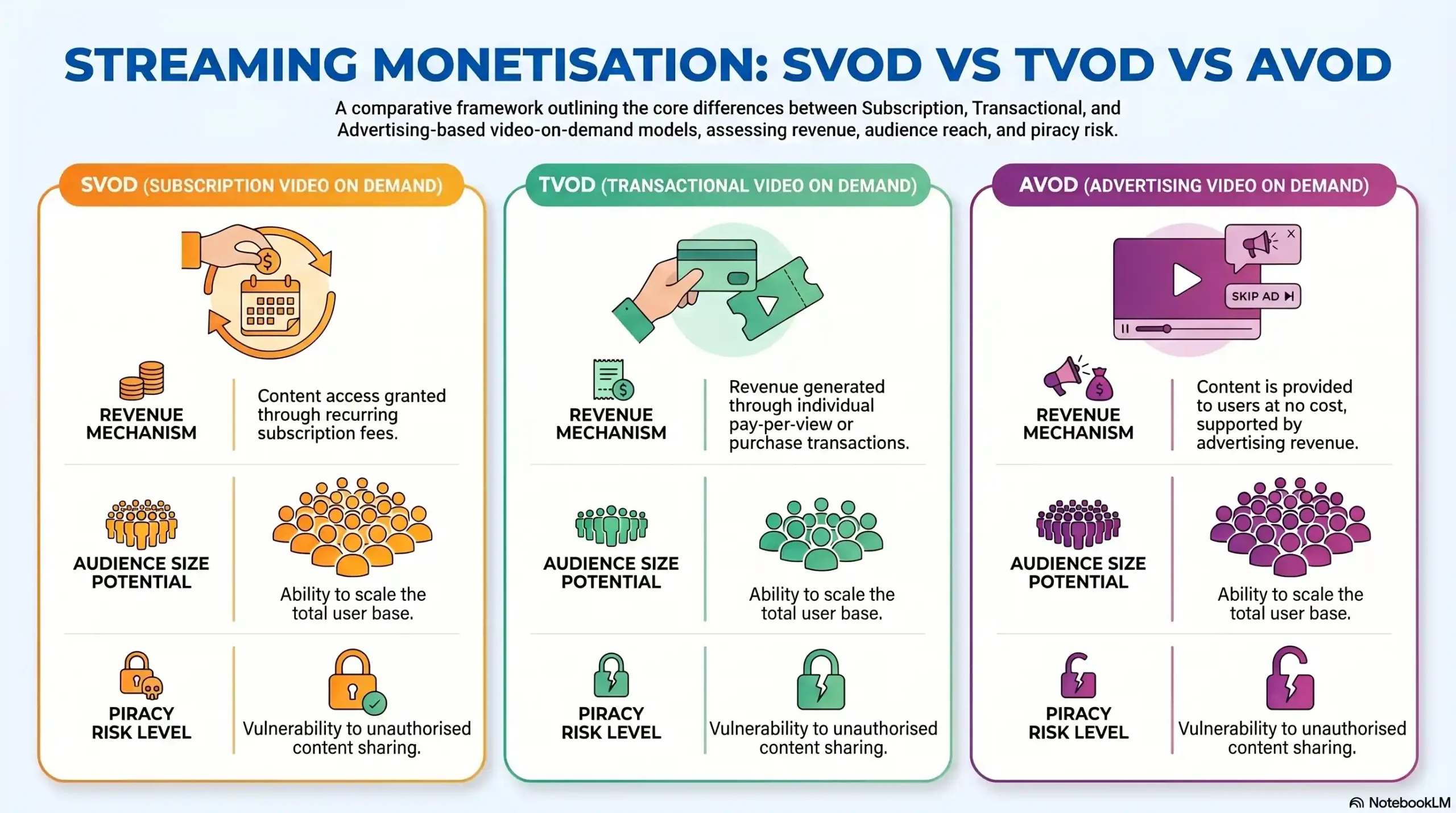
SVOD
- Revenue mechanism: Recurring subscription fee
- Audience reach: Medium — paying barrier filters casual viewers
- Revenue predictability: High — predictable monthly recurring revenue
- Piracy risk level: Medium — credential sharing is primary threat
TVOD
- Revenue mechanism: Per-title purchase or rental
- Audience reach: Low — highest payment barrier
- Revenue predictability: Low — dependent on content popularity
- Piracy risk level: High — paid content is prime piracy target
AVOD
- Revenue mechanism: Advertiser-funded, free to viewer
- Audience reach: High — no payment barrier maximizes reach
- Revenue predictability: Medium — tied to ad inventory and CPM rates
- Piracy risk level: Medium — stream ripping and rehosting
SVOD — Subscription Video on Demand
How SVOD Works
SVOD is the Netflix model. Viewers pay a recurring fee — monthly, quarterly, or annually — in exchange for unlimited access to your entire content library. From the platform operator’s perspective, SVOD is the gold standard for revenue predictability. Every subscriber represents a known, recurring revenue figure that compounds as your library and audience grow.
The mechanics are straightforward: a viewer signs up, enters payment details, and gains authenticated access to your content vault. Access is gated behind a login. The platform controls who sees what, when, and on which devices.
Pros and Cons of SVOD
Advantages:
- Predictable monthly recurring revenue (MRR) that scales with subscriber count
- Builds long-term audience loyalty and platform stickiness
- Enables deep investment in content library — subscribers expect volume
- Supports detailed analytics on viewing behavior and engagement
Disadvantages:
- Requires a substantial, consistently updated content library to justify the fee
- Subscriber churn is the platform’s greatest enemy — losing subscribers costs more than gaining them
- Higher barrier to entry — viewers must commit before experiencing value
- Subscription fatigue is real: by 2025, audiences were actively auditing and canceling underused subscriptions
Who Should Use SVOD?
SVOD is the right model for online course creators with deep curriculum libraries, media companies with ongoing content production pipelines, corporate training platforms that need controlled employee access, and premium content publishers whose audience expects consistent, exclusive content on a regular schedule.
If your content strategy is built around volume, consistency, and long-term audience relationships — SVOD is your model.
Piracy Risk in SVOD — The Credential Sharing Problem
SVOD’s Achilles heel is credential sharing. When a subscriber shares their login with five friends, your platform serves five viewers while collecting revenue for one. At scale, this is not a minor inconvenience — it is a structural revenue leak that compounds silently across your entire subscriber base.
Beyond credential sharing, SVOD libraries face screen recording attacks, where bad actors capture and redistribute entire content libraries. Without DRM encryption and dynamic watermarking, identifying the source of a leak — and stopping it — is virtually impossible.
Protecting your SVOD library starts with the right security infrastructure. Inkrypt Videos delivers military-grade DRM encryption and dynamic watermarking that identifies exactly who is sharing your content — and stops them.
TVOD — Transactional Video on Demand
How TVOD Works
TVOD — also called pay-per-view or transactional streaming — charges viewers per individual title, rental, or event. There is no subscription commitment. The viewer pays once, accesses the specific content they purchased, and the transaction is complete.
TVOD operates in two sub-models: rental (time-limited access, typically 24–72 hours) and purchase (permanent ownership of a title). Platforms like Apple TV, Amazon Prime Video’s add-on purchases, and live sports streaming services operate on TVOD or hybrid TVOD logic.
Pros and Cons of TVOD
Advantages:
- Maximizes revenue per title for high-demand, premium content
- No content library volume requirement — a single high-value piece can generate significant revenue
- Ideal for one-time events: live performances, exclusive premieres, specialized masterclasses
- Viewers self-select based on genuine intent — conversion quality is high
Disadvantages:
- Zero platform stickiness — viewers come, watch, and leave with no ongoing relationship
- Revenue is entirely dependent on individual title performance and marketing effectiveness
- Requires continuous content creation and promotion to sustain income
- Higher perceived risk for viewers unfamiliar with your content or brand
Who Should Use TVOD?
TVOD is the right model for live event producers, independent filmmakers releasing premium titles, online educators selling high-ticket masterclasses or workshops, and sports streaming platforms monetizing individual match access. If your content has a defined moment of peak value — a live premiere, a limited-access workshop, an exclusive sporting event — TVOD captures that value at its highest point.
Piracy Risk in TVOD — Why Pay-Per-View Content Is a Prime Target
Paid content is the highest-value piracy target in the VOD ecosystem. The moment a viewer pays for access to a premium title or live event, bad actors have both the motivation and the access window to record, capture, and redistribute that content for free. A live event pirated and restreamed in real time can drain your paying audience mid-broadcast.
TVOD platforms require per-transaction DRM licensing that authenticates every access attempt individually. Without forensic watermarking embedded at the viewer level, identifying which paying user became the source of a piracy leak is impossible — leaving you unable to take legal action or prevent repeat offenses.
AVOD — Advertising Video on Demand
How AVOD Works
AVOD removes the payment barrier entirely. Viewers access content for free, and the platform generates revenue by serving advertisements against that content. YouTube is the world’s most recognized AVOD platform, but the model extends far beyond user-generated content — premium publishers, news organizations, and entertainment networks all operate AVOD channels.
Revenue in AVOD is driven by CPM rates (cost per thousand impressions), ad inventory fill rates, and total watch time. The larger and more engaged your audience, the greater your advertising revenue potential.
Pros and Cons of AVOD
Advantages:
- Maximum audience reach — no payment barrier means no friction for new viewers
- Effective for brand building and audience development at scale
- Works well alongside SVOD as a free tier to drive subscription upgrades
- Growing advertiser demand for premium OTT inventory is pushing CPM rates upward
Disadvantages:
- Revenue per viewer is significantly lower than SVOD or TVOD
- Entirely dependent on advertiser demand — CPM rates fluctuate with market conditions
- Ad experience can negatively impact premium content perception
- Audience loyalty is lower — free content creates lower emotional investment
Who Should Use AVOD?
AVOD is the right model for media brands prioritizing audience scale over per-viewer revenue, platforms using a freemium strategy to funnel viewers toward paid tiers, educational platforms offering introductory content to drive course sales, and content publishers in price-sensitive markets where subscription models face adoption barriers.
Piracy Risk in AVOD — Why “Free” Content Still Gets Stolen
A common misconception is that AVOD content — being free — is not worth stealing. This is wrong in two important ways. First, content pirates strip advertisements from AVOD streams and rehost clean versions, directly stealing the ad impressions your revenue depends on. Second, if your AVOD library includes any premium or exclusive content, that content is equally exposed to screen recording and unauthorized redistribution. Even free content requires protection when your business model depends on controlling where and how it is consumed.
SVOD vs TVOD vs AVOD — Direct Model Comparison
Revenue Predictability
SVOD delivers the most predictable revenue — your MRR is calculable, forecastable, and compounds with subscriber growth. AVOD sits in the middle — ad revenue is relatively consistent but subject to market fluctuations. TVOD is the least predictable — revenue swings dramatically based on individual content performance and release timing.
Audience Reach
AVOD wins on reach — free content removes every barrier to entry. SVOD builds deeper but narrower audiences of committed, paying viewers. TVOD has the smallest potential audience pool — requiring viewers to make an individual payment decision for each piece of content.
Content Protection Requirements
All three models require content protection — but the threat profile differs. SVOD needs credential-sharing controls and library-wide DRM. TVOD needs per-transaction authentication and forensic watermarking for leak identification. AVOD needs stream protection to prevent ad-stripping and unauthorized rehosting.
Best Fit by Content Type
Online course library
- Best model: SVOD
- Reason: Volume justifies subscription; ongoing engagement
Live events & premieres
- Best model: TVOD
- Reason: Peak value capture at moment of release
Introductory / brand content
- Best model: AVOD
- Reason: Scale-first approach builds top-of-funnel
Film & series catalogue
- Best model: SVOD or Hybrid
- Reason: Consistent library access drives retention
Niche masterclasses
- Best model: TVOD
- Reason: High perceived value supports premium pricing
News & editorial content
- Best model: AVOD
- Reason: Reach and ad revenue over per-view pricing
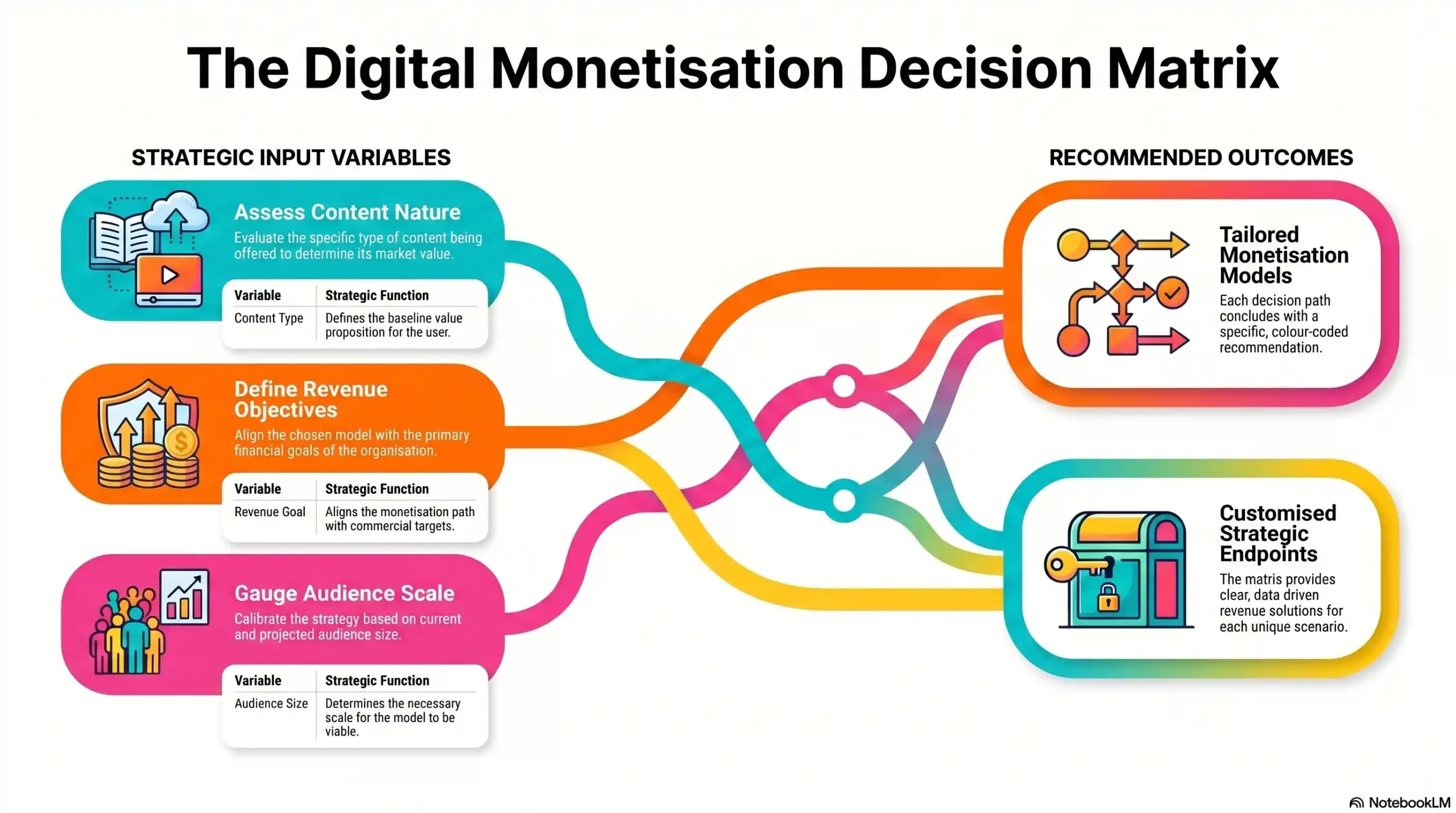
Predictable recurring revenue
- Recommended model: SVOD
- Secondary option: HVOD (Hybrid)
Maximum audience reach
- Recommended model: AVOD
- Secondary option: HVOD (Free tier)
Premium per-title revenue
- Recommended model: TVOD
- Secondary option: HVOD (TVOD layer)
Scale + monetization balance
- Recommended model: HVOD
- Secondary option: SVOD + AVOD
Live event monetization
- Recommended model: TVOD
- Secondary option: SVOD (event add-on)
Course creator with deep library
- Recommended model: SVOD
- Secondary option: TVOD (flagship courses)
The Rise of Hybrid Monetization — HVOD
What Is HVOD and Why Platforms Are Shifting
The clean lines between SVOD, TVOD, and AVOD are dissolving. In 2026, the dominant model for sophisticated platforms is HVOD — Hybrid Video on Demand — which deliberately combines elements of two or more monetization approaches within a single platform.
The shift is not accidental. Subscription fatigue has reached critical mass. Even Netflix — the defining SVOD platform — now operates a significant ad-supported tier. Amazon Prime Video introduced ads to its core subscription offering. When the largest platforms on earth cannot survive on subscriptions alone, the writing on the wall is clear: a single-model approach limits your revenue ceiling and your audience reach simultaneously.
How to Combine SVOD + TVOD + AVOD Without Losing Control
A well-structured HVOD platform typically operates across three tiers. The free AVOD tier maximizes reach and serves as the top-of-funnel entry point. The mid-tier SVOD subscription converts engaged free viewers into paying subscribers with an ad-free or reduced-ad experience. The TVOD premium layer sits above the subscription, offering individual purchase access to flagship releases, live events, or exclusive masterclasses.
The critical operational challenge of HVOD is not the revenue model — it is content control. When your platform operates across three tiers simultaneously, ensuring the right content is accessible to the right viewer at the right tier — and no further — demands a security infrastructure that operates at the same level of sophistication as your monetization strategy.
Running a hybrid monetization model? Inkrypt Videos protects every tier — from your free AVOD library to your premium SVOD vault and TVOD pay-per-view events — with one unified security layer. No complexity. No compromises. Setup in 30 minutes.