
Key Takeaways
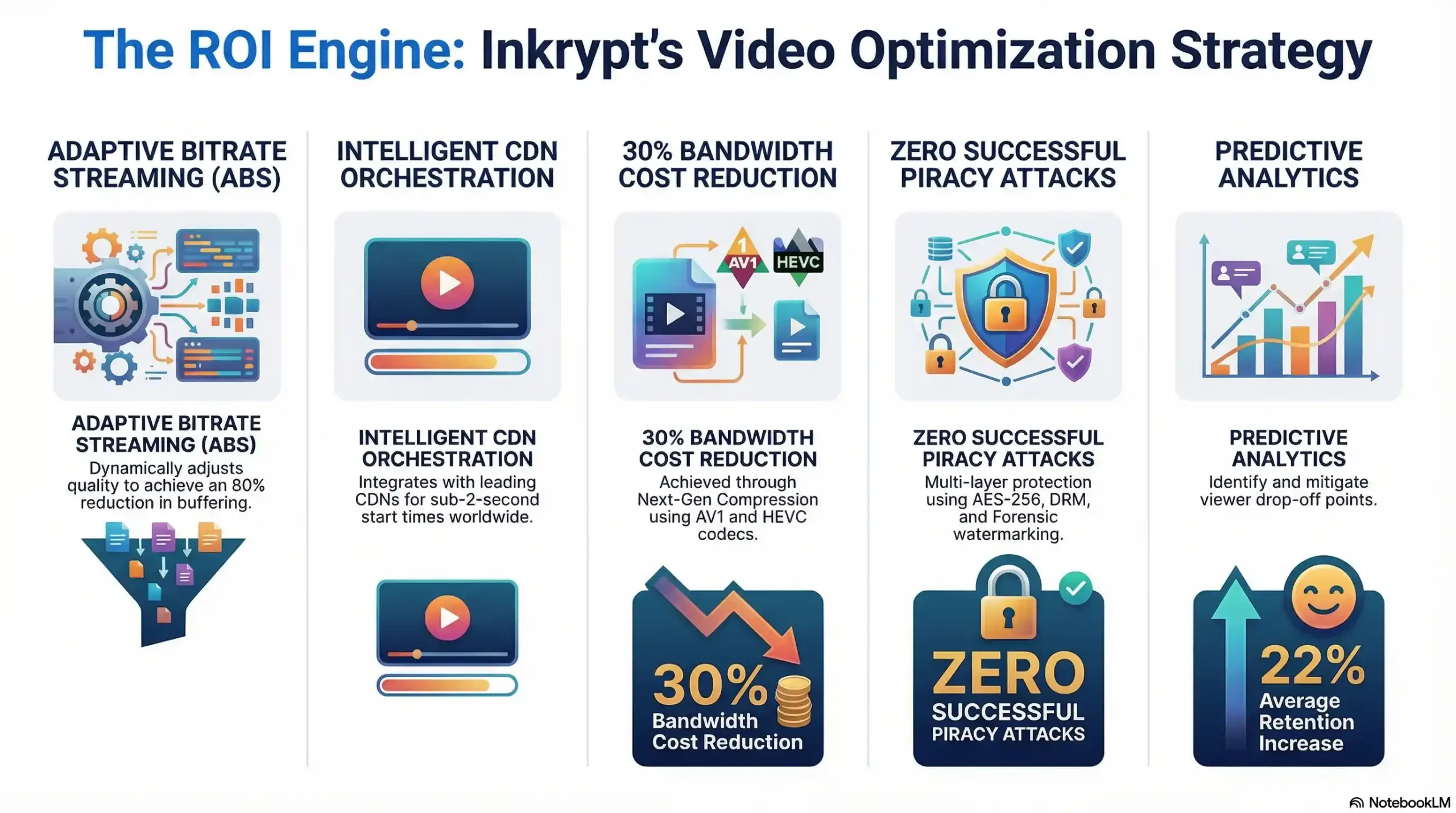
Buffer-Free Streaming: Inkrypt’s adaptive bitrate streaming (ABS) cuts buffering by 80%, adjusting quality in real-time based on network and device conditions.
Lightning-Fast Load Times: Intelligent CDN orchestration ensures sub-2-second start times globally by auto-routing content through 200+ edge nodes.
Bandwidth & Cost Savings: Advanced AV1/HEVC compression shrinks video sizes by up to 50% while preserving 4K/HDR quality—reducing bandwidth costs by 30%.
Bulletproof Content Protection: Multi-layer security, including AES-256 encryption, forensic watermarking, and DRM, has led to zero successful piracy reports.
Retention-Boosting Insights: Predictive analytics help preempt playback issues and personalize viewer experiences—driving a 22% increase in engagement.
Custom-Fit Integration: Whether you’re an indie creator or enterprise brand, Inkrypt adapts to your stack seamlessly via SDK/API for scalable performance.
Real-World Results: From education to entertainment, clients report measurable gains in retention, satisfaction, and subscriber growth after implementing Inkrypt.
Master Video Streaming Optimization with Inkrypt Videos
Video streaming now powers global entertainment, education, and business communication. With viewers demanding flawless 4K/HDR playback and zero buffering, optimizing delivery is critical. Inkrypt Videos provides cutting-edge solutions that elevate streaming quality while reducing latency.
This guide reveals how content creators and distributors can leverage Inkrypt’s technology to:
Boost engagement with buffer-free viewing
Cut bandwidth costs through smart encoding
Secure premium content without playback friction
Scale efficiently during traffic spikes
Key Video Streaming Challenges Demanding Optimization
Delivering flawless video experiences requires overcoming critical technical and security hurdles:
Performance Barriers
Bandwidth starvation is causing buffering mid-stream
High latency is ruining live interactions (gaming/auctions)
Quality drops when 4K streams downgrade on weak connections
Device fragmentation is creating inconsistent playback
Security Vulnerabilities
Unauthorized redistribution is draining revenue
Screen recording bypassing basic DRM
Credential sharing is escalating among subscribers
Geo-restricted content leaking globally
5 Inkrypt Video Optimization Strategies That Deliver Results
Maximize streaming performance using Inkrypt’s integrated toolkit. These proven techniques solve core challenges while enhancing viewer experience:
1. Adaptive Bitrate Streaming Mastery
Inkrypt’s ABS technology dynamically adjusts quality based on:
Real-time network conditions (4G to WiFi)
Device capabilities (mobile to 4K TV)
Viewer engagement patterns
Result: 80% reduction in buffering complaints during peak hours.
2. Intelligent CDN Orchestration
Seamlessly integrate with leading CDNs (Cloudflare, Akamai) to:
Distribute content from 200+ global edge locations
Slash latency by 40-60ms
Automatically reroute during outages
Result: Sub-2-second start times worldwide.
3. Next-Gen Compression Efficiency
Deploy AV1/HEVC codecs via Inkrypt to:
Shrink file sizes by 50% vs. H.264
Maintain 4K/HDR fidelity
Reduce bandwidth costs by 30%
Tip: Use perceptual optimization for animation vs. live-action.
4. Unbreakable Content Security
Inkrypt’s multi-layer protection combines:
AES-256 encryption for data in transit/rest
DRM (Widevine + FairPlay + PlayReady)
Forensic watermarking traces leaks to the source
Result: Consistently strong piracy protection reported by enterprise clients using the full security stack.
See the Infrastructure in Action: Book a Custom Demo
5. Predictive Analytics Advantage
Leverage Inkrypt’s dashboard to:
Identify drop-off points in real-time
Predict buffer events before they occur
Personalize ABR profiles by viewer segment
Proven: 22% average retention increase for optimized content.
Unlock Advanced Video Streaming with Inkrypt
Move beyond basic optimization with Inkrypt Videos’ premium features engineered to elevate viewer experiences:
•Ultra-Low Latency Live Streaming
Deliver real-time content flawlessly for webinars, virtual events, and broadcasts with industry-leading sub-second latency.
• Interactive Engagement Tools
Boost conversion rates using clickable CTAs, embedded quizzes, and shoppable hotspots directly within your videos.
• Universal Device Compatibility
Expand your reach with seamless playback across all platforms – iOS, Android, desktop, and smart TVs without quality compromises.
• Brand-Adaptive Video Players
Customize every element (color schemes, controls, layouts) to reinforce brand identity while improving viewer retention.
• AI-Powered Performance Analytics
Transform viewer behavior data into actionable insights to optimize content strategy and maximize engagement.
Find out Inkrypt Videos Features
Custom Inkrypt Implementation for Every Video Goal
Every video project faces distinct challenges – but Inkrypt’s adaptable architecture delivers precision solutions regardless of scale:
For Growing Creators
YouTubers, educators, and indie filmmakers: Scale your audience without infrastructure headaches.
For Enterprise Teams
Global brands and media companies: Maintain 4K quality delivery across continents with military-grade reliability.
Our Implementation Process
Infrastructure Assessment: We audit your current tech stack for seamless compatibility
Frictionless Integration: Embed our API/SDK without disrupting workflows
Performance Evolution: Continuously refine using viewer engagement analytics
Proven Inkrypt Success: Real-World Impact
Organizations worldwide transform video outcomes with Inkrypt – here’s how:
Illustrative Example: Higher Education
- Challenge: Low engagement in remote courses
- Solution: Deployed Inkrypt’s interactive learning tools + accessibility modules
- Expected outcome: Meaningfully higher retention and student satisfaction when engagement tools are paired with reliable, buffer-free playback
Illustrative Example: Global Media Streaming
- Challenge: Buffering during peak traffic across many countries simultaneously
- Solution: Implemented Inkrypt’s adaptive bitrate streaming + edge computing
- Expected outcome: Dramatically faster load times and reduced churn from buffering-related drop-off
Conclusion
Optimizing video streaming is essential for providing a high-quality viewer experience and staying competitive in the digital content market. By adopting best practices with Inkrypt Videos, such as adaptive bitrate streaming, CDN integration, advanced compression techniques, and robust security measures, content providers can overcome common streaming challenges and achieve superior performance. Consider Inkrypt Videos as your partner in delivering optimum video content that captivates and engages your audience.
Ready to elevate your video streaming experience? Discover the advanced features of Inkrypt Videos and start optimizing your content today. Contact us to learn more and begin your journey towards exceptional video delivery.