
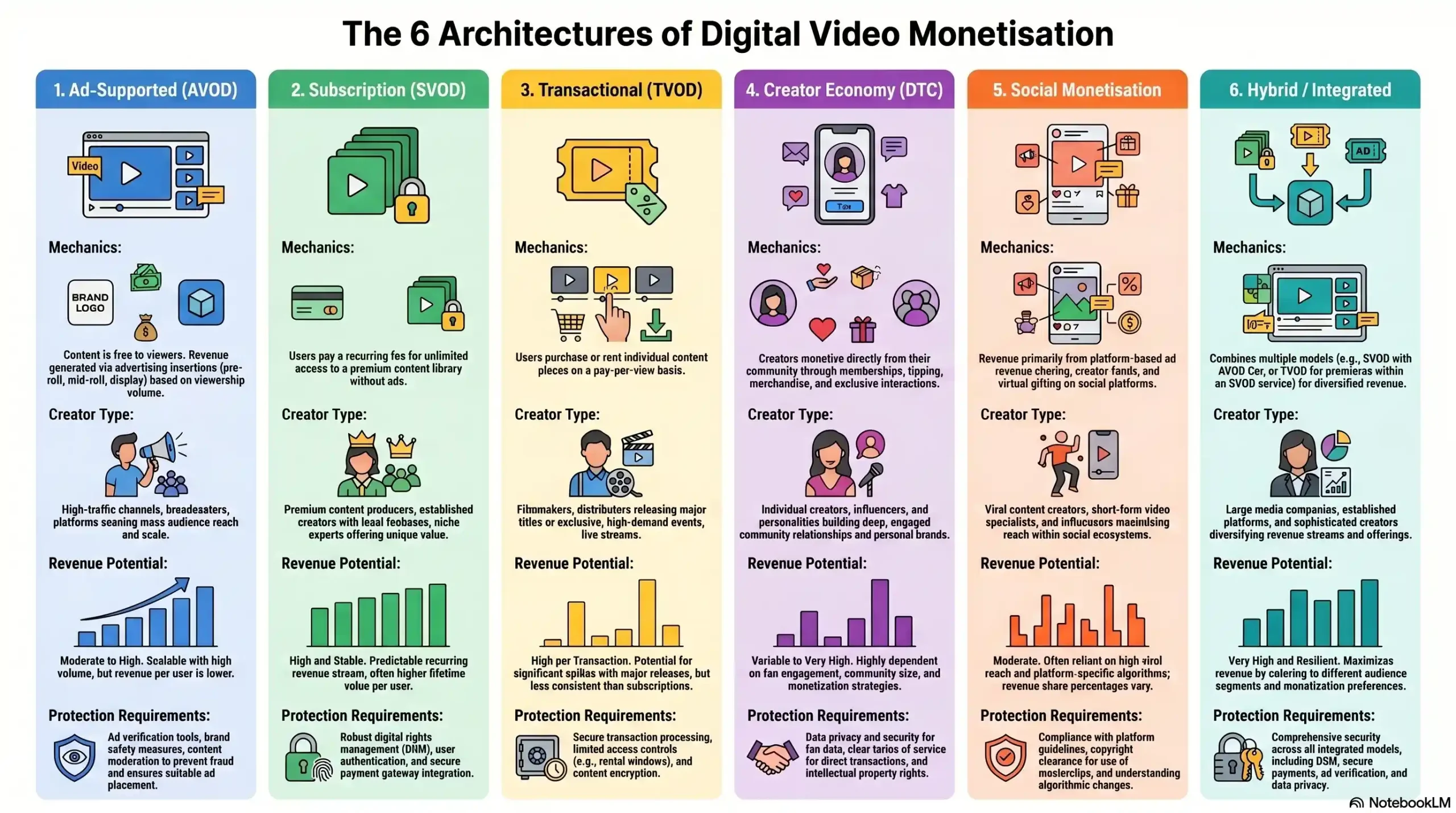
SVOD
- How it works: Monthly/annual subscription fee
- Ideal for: Educators, fitness, niche media
- Avg. revenue potential: $5K–$50K/month
- Protection requirement: Credential sharing prevention
TVOD
- How it works: One-time purchase or rental
- Ideal for: Events, premium content, films
- Avg. revenue potential: $10–$200 per transaction
- Protection requirement: Encrypted delivery, no redistribution
Online Courses
- How it works: Fixed-price course enrollment
- Ideal for: Coaches, educators, consultants
- Avg. revenue potential: $500–$5,000 per course
- Protection requirement: DRM + watermarking + access control
AVOD
- How it works: Free content monetized via ads
- Ideal for: High-volume creators, media brands
- Avg. revenue potential: $2–$15 per 1,000 views (CPM)
- Protection requirement: CDN performance + brand safety
Licensing & Syndication
- How it works: Content sold to third-party platforms
- Ideal for: Filmmakers, journalists, educators
- Avg. revenue potential: $500–$50,000 per license
- Protection requirement: Dynamic watermarking + usage tracking
Hybrid / Freemium
- How it works: Free tier + paid premium tier
- Ideal for: SaaS-style content businesses
- Avg. revenue potential: Variable, model-dependent
- Protection requirement: Tiered access control
Revenue Model #1 — Subscription Video on Demand (SVOD)
How SVOD Works for Independent Creators
Subscription Video on Demand is the most predictable and scalable video revenue model available to independent creators in 2026. Subscribers pay a recurring monthly or annual fee in exchange for unlimited access to a content library. The appeal is straightforward: one piece of content, produced once, generates revenue indefinitely.
For creators with an established audience — fitness coaches, language educators, niche documentary producers, or professional development instructors — SVOD provides reliable monthly recurring revenue (MRR) that compounds as the library grows. Platforms built on SVOD typically see 60–80% of revenue come from content produced more than six months prior, making it a genuinely passive income model at scale.
The key metrics that determine SVOD success are subscriber acquisition cost, monthly churn rate, and average revenue per user (ARPU). In 2026, top-performing independent SVOD creators maintain churn rates below 5% monthly by combining consistent new content with community features that increase platform stickiness.
How to Protect SVOD Revenue from Credential Sharing
The greatest threat to SVOD revenue is not churn — it is credential sharing. When a single subscriber account is shared among multiple non-paying users, revenue is directly suppressed without appearing in any analytics dashboard. Studies suggest that for every paying SVOD subscriber on an unprotected platform, an average of 2.3 additional users access content for free through shared credentials.
Protecting SVOD revenue requires a hosting platform that enforces concurrent stream limits, IP-based access controls, and device authentication. DRM encryption ensures that even subscribers who download content for offline viewing cannot redistribute those files. For independent SVOD operators, these are not enterprise-only features — they are table-stakes requirements for running a profitable subscription business.
Revenue Model #2 — Transactional Video on Demand (TVOD)
Pay-Per-View vs. Permanent Download Models
Transactional Video on Demand operates on a one-time payment structure — viewers pay either to rent content for a limited window or to purchase permanent access. This model is particularly effective for high-value, time-sensitive content: live event recordings, premium masterclasses, sports broadcasts, or feature-length productions.
TVOD offers higher per-transaction revenue than SVOD but requires a larger individual purchase decision from the viewer. In 2026, the most successful TVOD operators use a hybrid approach — offering a rental option at a lower price point to reduce friction, with a permanent purchase option at a premium. Conversion rates from rental to purchase average 12–18% among engaged viewers, making the rental tier an effective top-of-funnel entry point.
Why Encrypted Delivery Is Non-Negotiable for TVOD
Unlike SVOD, where value is tied to ongoing access, TVOD content is typically a one-time transaction. This makes unauthorized redistribution disproportionately damaging — a single pirated copy of a $97 masterclass eliminates the entire revenue potential of every viewer who watches the pirated version instead of purchasing.
Encrypted delivery using industry-standard DRM protocols ensures that purchased or rented content cannot be downloaded via browser tools, screen-capture utilities, or stream-ripping software. For TVOD operators, the investment in encrypted hosting infrastructure is recovered within the first prevented piracy incident at meaningful scale.
Revenue Model #3 — Online Courses & Cohort Programs
Why Course Creators Are the Fastest-Growing Video Revenue Segment
The online education market is the single fastest-growing segment of video monetization in 2026, projected to reach $350 billion globally by 2027. Course creators — coaches, consultants, subject-matter experts, and professional educators — are generating life-changing revenue from structured video content delivered directly to students without intermediary platforms taking the majority of the margin.
The course model offers several structural advantages over other video revenue models. Revenue is realized upfront at enrollment rather than spread across a subscription period. Cohort-based courses, where students move through material in groups over a defined timeframe, command premium pricing ($500–$5,000 per enrollment) because of the community and accountability components. Self-paced courses offer lower price points but near-zero marginal delivery cost at scale.
For creators already producing content in a defined expertise area, the course model represents the highest revenue-per-viewer ratio of any model in this article.
Protecting Course ROI: DRM, Watermarking & Access Control
Course content represents the highest-value asset in a creator’s library — and the most frequently targeted by piracy operations. A course that took 200 hours to produce and sells for $1,000 per enrollment can generate millions in legitimate revenue. It can also be screen-recorded, re-uploaded to file-sharing sites, and distributed for free within 48 hours of launch if unprotected.
Protecting course ROI requires three layers of security working simultaneously. DRM encryption prevents downloading and redistribution at the file level. Dynamic watermarking embeds unique viewer-identifying data into each playback session, enabling forensic identification of the source of any leaked copy. Access control — including student-specific login enforcement, IP monitoring, and device limits — prevents credential sharing from suppressing enrollment revenue.
🟠 Ready to launch your course with bulletproof content protection? Get started with Inkrypt Videos.
Revenue Model #4 — Ad-Supported Streaming (AVOD)
Ad-Supported Video on Demand is the model most familiar to creators who built their audience on YouTube, but it is increasingly viable as a standalone monetization strategy on owned platforms in 2026. AVOD generates revenue through pre-roll, mid-roll, and display advertising served against free content, with CPMs ranging from $2 to $15 depending on audience demographics, content category, and geographic distribution.
How CDN Performance Directly Impacts Ad Revenue
The relationship between video delivery performance and AVOD revenue is direct and measurable. Buffering events and load delays cause viewer abandonment — and abandoned views generate zero ad impressions. Studies show that a single buffering event increases viewer abandonment probability by 39%. On a platform generating one million monthly views, the difference between a 2% and a 5% buffering rate can represent tens of thousands of dollars in lost ad revenue annually.
A high-performance global CDN — one that routes content delivery through geographically distributed servers to minimize latency for viewers worldwide — is not a luxury for AVOD operators. It is the single most direct investment a creator can make in protecting ad revenue. For creators targeting global English-speaking audiences, CDN coverage across North America, Europe, Asia-Pacific, and the Middle East is a baseline requirement in 2026.
Revenue Model #5 — Video Licensing & Content Syndication
Video licensing is one of the most underutilized revenue models among independent creators, and one of the highest-margin opportunities available in 2026. Licensing allows creators to sell the rights to use their content to third-party platforms, broadcasters, educational institutions, or corporate training programs — generating revenue from existing content without creating anything new.
Syndication extends this further: content is distributed across multiple platforms simultaneously, each paying a licensing fee or revenue share. A single high-quality educational video series can be licensed to a corporate training platform, a university continuing education program, and a regional broadcaster simultaneously — generating three independent revenue streams from one content asset.
How Dynamic Watermarking Makes Your Content Licensable
For video content to be commercially licensable, two conditions must be met: the content must be provably original, and the licensor must be able to track and enforce how it is used after distribution. Dynamic watermarking satisfies both conditions.
By embedding unique, invisible identifiers into each licensed copy of a video, creators can forensically trace any unauthorized redistribution back to the specific licensee who received that copy. This capability transforms content from a liability — something that could be stolen and redistributed — into a controlled asset with a verifiable chain of custody. In 2026, enterprise licensees and institutional buyers actively require forensic watermarking capability as a condition of licensing agreements.
Revenue Model #6 — Hybrid & Freemium Video Models
Combining Free and Paid Tiers Without Losing Control
The hybrid freemium model — where a meaningful portion of content is offered free to build audience, with premium content gated behind a paywall — is the dominant monetization architecture used by the most successful independent video businesses in 2026. It combines the audience-building advantages of free content with the revenue discipline of a paid tier.
The critical design challenge in a freemium model is the free-to-paid conversion boundary. Free content must be valuable enough to build trust and demonstrate expertise, but the paid tier must offer a clearly superior experience that justifies the upgrade. In practice, this means the free tier contains introductory or evergreen content, while the paid tier contains actionable, advanced, or live-interaction content that cannot be easily replicated elsewhere.
The hidden vulnerability of the freemium model is access control failure at the paywall boundary. Without robust authentication and session management, determined viewers can bypass payment gates through shared credentials, cached sessions, or URL manipulation. Secure hosting infrastructure with tiered access control — enforced at the server level, not just the front-end interface — is what separates a profitable freemium business from one that gives away premium content for free.
Coach / Educator
- Audience size: Under 5,000
- Content type: Structured curriculum
- Recommended model: Online Courses
- Secondary model: SVOD
Fitness / Lifestyle
- Audience size: 5,000–50,000
- Content type: Regular episodic
- Recommended model: SVOD
- Secondary model: Hybrid Freemium
Filmmaker / Producer
- Audience size: Any
- Content type: Long-form, event
- Recommended model: TVOD
- Secondary model: Licensing
Media Brand
- Audience size: 50,000+
- Content type: Mixed library
- Recommended model: AVOD + SVOD
- Secondary model: Syndication
Enterprise Trainer
- Audience size: B2B
- Content type: Corporate curriculum
- Recommended model: Licensing
- Secondary model: TVOD
Niche Expert
- Audience size: Under 10,000
- Content type: Deep expertise
- Recommended model: Hybrid Freemium
- Secondary model: Online Courses
Local Resources & Citations — Trust Booster
1. U.S. Copyright Office
The official federal authority for registering and protecting original video content — check here to formally copyright your course or video library before monetizing, giving you legal standing to enforce against piracy worldwide.
2. World Intellectual Property Organization (WIPO)
The United Nations agency governing global intellectual property rights — reference here for international copyright treaties, cross-border content licensing frameworks, and legal protections for video creators distributing content outside the United States.
3. U.S. Federal Trade Commission — Digital Advertising Guidelines
The official U.S. regulatory authority for digital advertising standards — consult here to ensure your AVOD ad placements, sponsored video content, and affiliate disclosures meet federal compliance requirements before monetizing.
4. MIT OpenCourseWare — Online Education Research
An educational (.edu) reference from the Massachusetts Institute of Technology — cite here to support the credibility of online course monetization claims, as MIT’s open courseware program demonstrates the global demand and institutional validation of structured video-based learning.
How to Choose the Right Video Monetization Model for Your Business
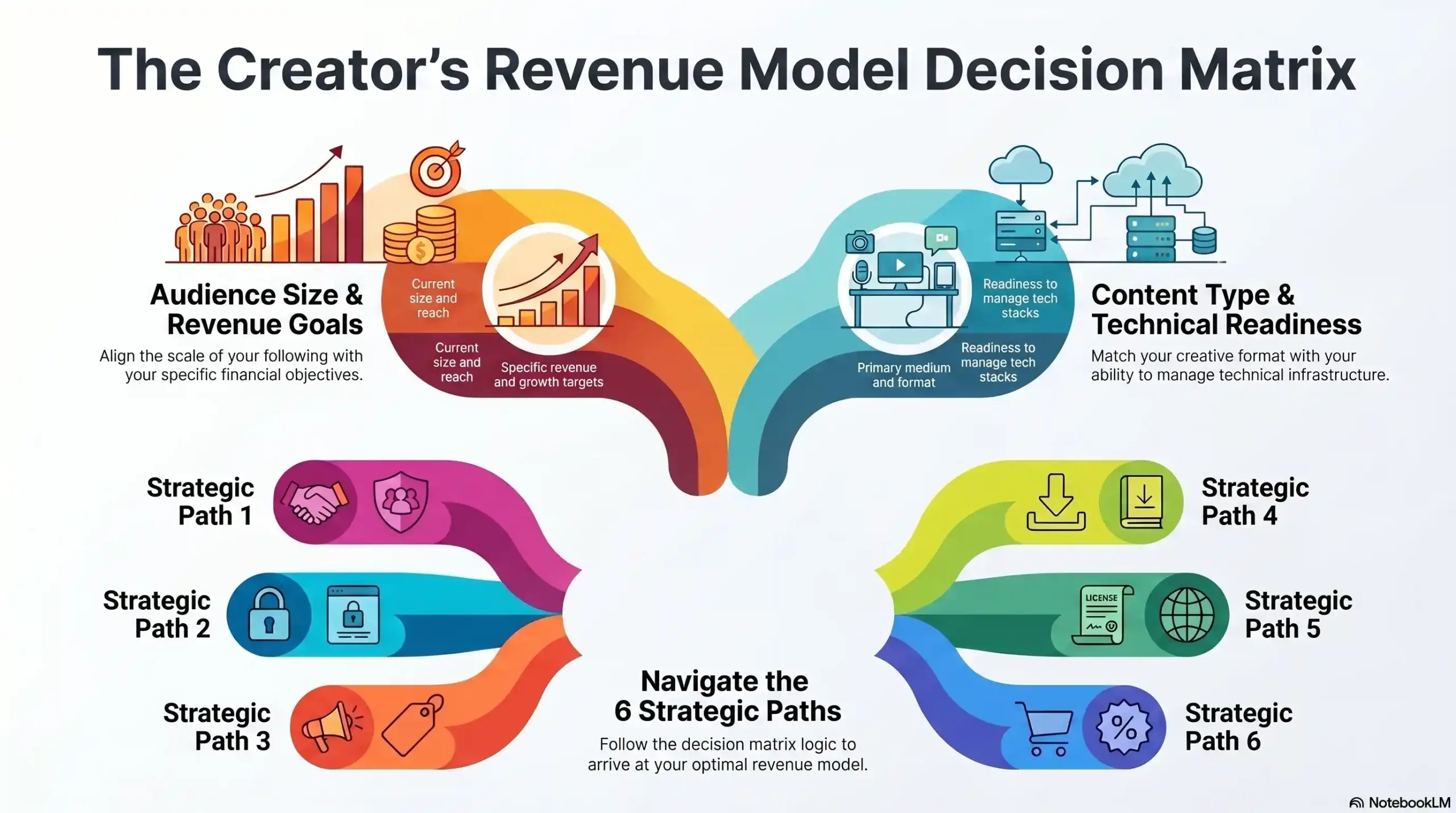
No single revenue model is optimal for every creator, and the most financially resilient video businesses in 2026 operate across two or three models simultaneously. The selection framework is straightforward: match the model to your audience size, your content format, your technical capacity, and your revenue timeline.
Creators in the early stages of audience building — under 5,000 engaged followers — generate the highest return from the online course model, where deep expertise commands premium pricing independent of audience scale. Creators with established audiences above 50,000 engaged viewers unlock the full potential of SVOD, AVOD, and syndication simultaneously.
The 2026 trend shaping every model is AI-assisted content personalization and dynamic pricing. Platforms that deliver personalized content recommendations within a subscription or course environment see 30–45% lower churn rates. Dynamic pricing — where paywall entry prices adjust based on viewer behavior, geographic market, or content engagement signals — is emerging as a standard feature of mature video monetization platforms.
The common thread running through every model is this: the creator who controls access to their content controls their revenue. Every dollar invested in secure, encrypted video infrastructure is a direct investment in the integrity of every monetization model built on top of it.
🟠 Start monetizing your video content with the security it deserves. Contact Inkrypt Videos today.