To build a paywalled video platform in 2026, you need five core layers: secure cloud video hosting, DRM encryption (Widevine/PlayReady/FairPlay), dynamic video watermarking, token-based access control, and a payment gateway. The fastest path is a purpose-built SaaS platform like Inkrypt Videos, which delivers all five layers with a 30-minute setup — no DevOps required. For course creators, media publishers, and enterprise teams, this approach eliminates months of custom development while providing military-grade content protection.
Why Building a Paywalled Video Platform Is a Smart Business Move in 2026
The creator economy has matured. Audiences in 2026 expect premium video experiences — and they are willing to pay for them. But here is the problem no one talks about loudly enough: for every dollar your paywalled platform earns, a portion is being silently stolen.
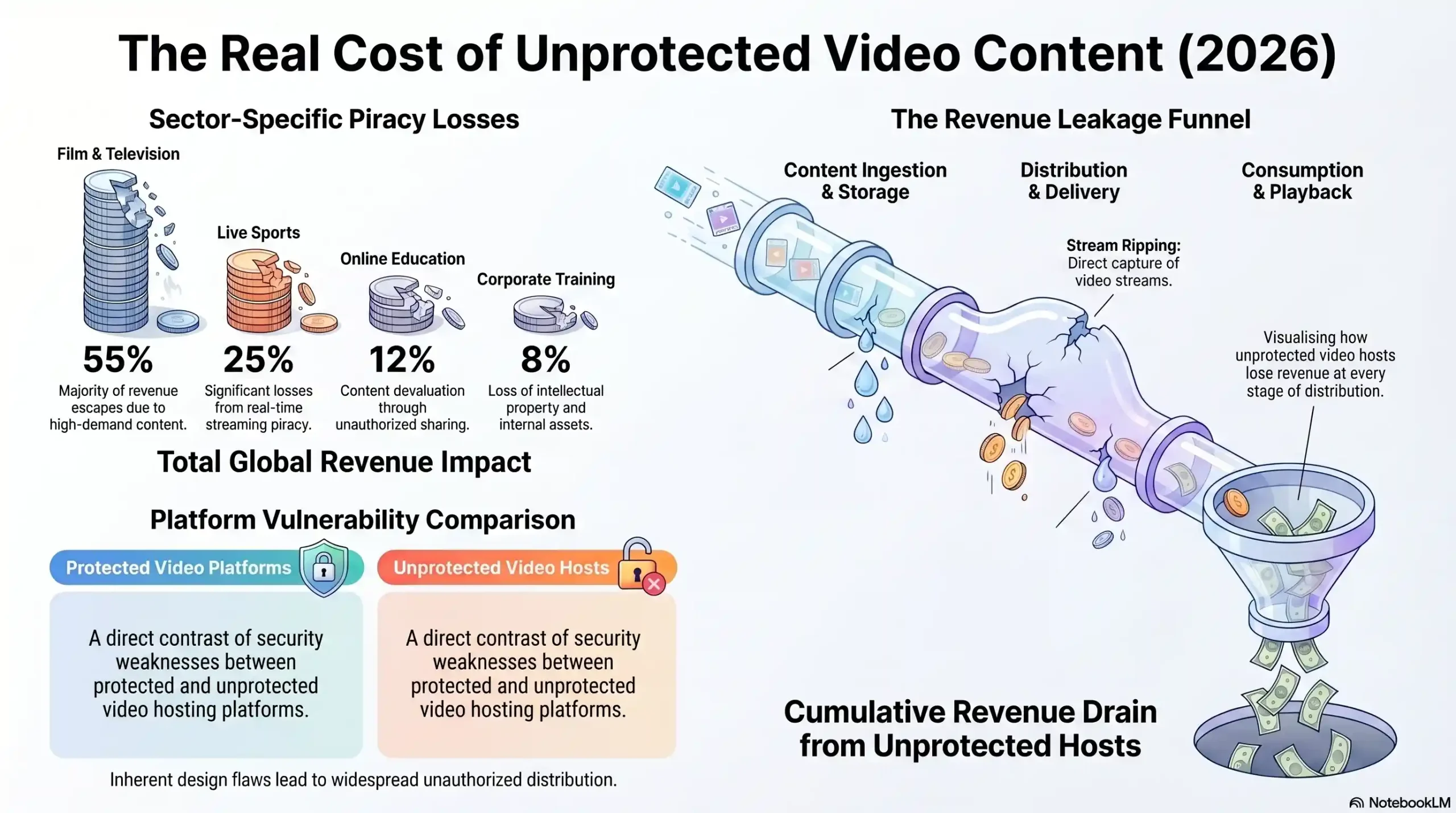
Online video piracy now costs the global media industry an estimated $75 billion per year in lost revenue — a figure projected to climb to $125 billion by 2028. Piracy sites recorded over 216 billion visits in 2024 alone. These are not abstract numbers. They represent real courses downloaded and reshared on Telegram, real subscription accounts passed between dozens of unauthorized users, and real creators watching their revenue plateau while their content circulates freely on piracy networks.
The problem is not that creators are building paywalled platforms. The problem is that most of them are building them on the wrong foundations.
Generic platforms like YouTube and Vimeo were designed for reach, not restriction. Uploading your premium course or exclusive media content to a platform built for free, open distribution — then slapping a password on it — is not a paywall. It is a polite suggestion. Sophisticated pirates bypass it in minutes.
In 2026, building a truly paywalled video platform means building one where the protection lives inside the video itself, not just in front of it.
Global video piracy losses (annual)
- ~$75 billion/year
Projected losses by 2028
- ~$125 billion/year
Piracy site visits in 2024
- 216+ billion
Annual piracy growth rate
- ~11% per year
US content industry loss (digital video)
- $29.2B–$71B annually
Platforms with real DRM enforcement
- Less than 20% of the market
What You Actually Need to Build a Paywalled Video Platform
Before you choose a platform or write a single line of code, you need to understand the five technical layers that separate a real paywalled platform from a false sense of security.
1. Secure Video Hosting Infrastructure
Your video files need a home that is built for both scale and security. Cloud-based hosting has become the standard in 2026 — not because it is trendy, but because self-hosted infrastructure cannot match the redundancy, uptime guarantees, and global delivery capabilities of enterprise cloud systems.
Critically, your hosting layer must be paired with a global Content Delivery Network (CDN). A CDN stores cached versions of your video content across servers worldwide, so a student in Tokyo and a subscriber in São Paulo both experience the same fast, buffer-free playback. Platforms powered by Amazon CDN — like Inkrypt Videos — deliver this performance at enterprise scale without requiring you to manage a single server.
2. DRM Encryption — The Non-Negotiable Core
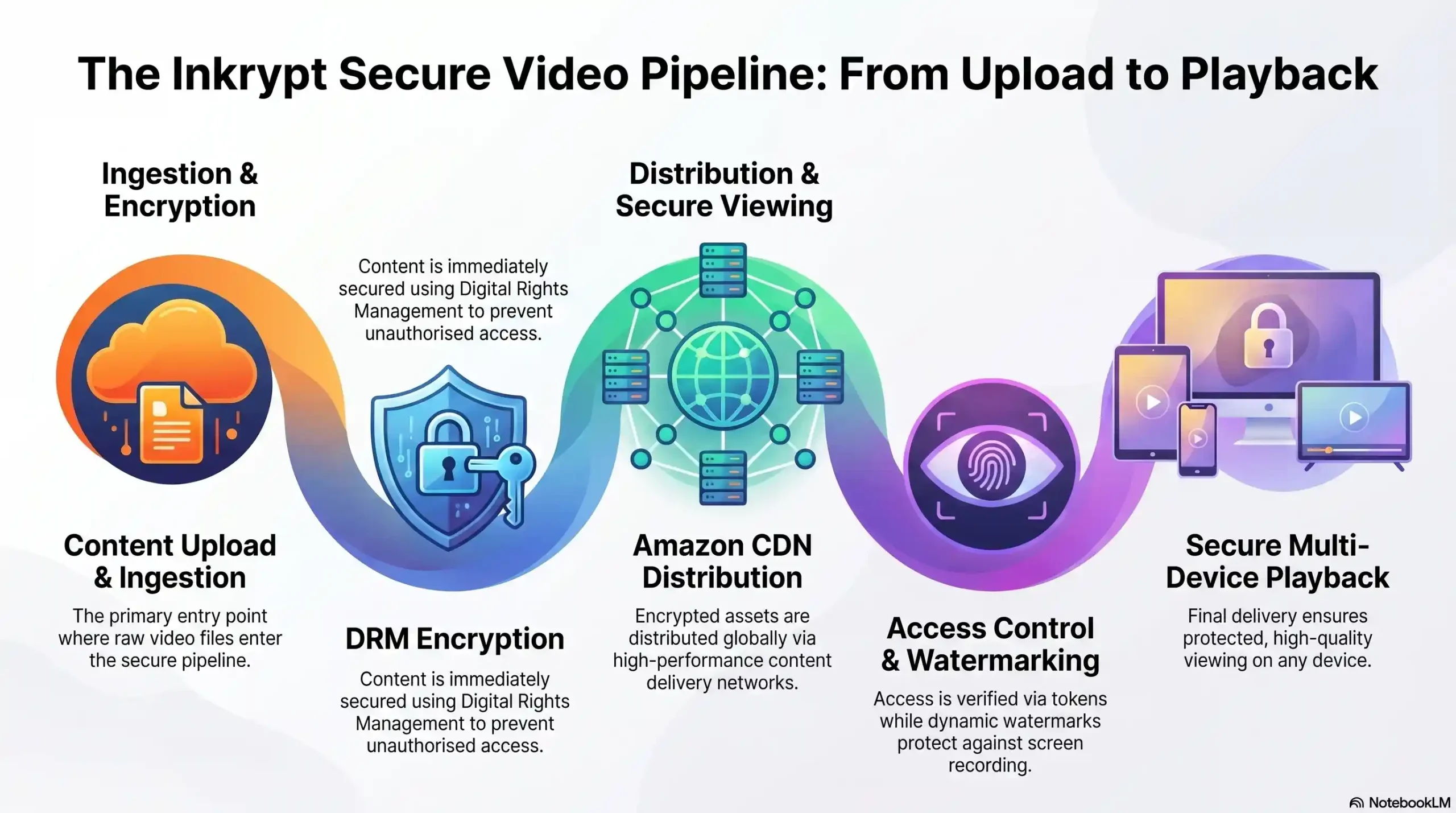
Digital Rights Management (DRM) is the technology that enforces how your content can be played, on which devices, and by whom. The three dominant DRM systems in 2026 are Widevine (Google, Android, Chrome), PlayReady (Microsoft, Windows, Xbox), and FairPlay (Apple, Safari, iOS).
A common misconception is that AES (Advanced Encryption Standard) stream encryption is enough. It is not. AES encrypts the stream in transit, but it does not enforce playback rules. A determined bad actor can still capture, decode, and redistribute AES-encrypted content. DRM adds a critical enforcement layer: the video will not play at all without a license token issued to an authenticated user on an authorized device.
This is the gap between platforms that offer “secure hosting” as a marketing term and platforms like Inkrypt Videos that implement multi-DRM encryption as a technical reality.
3. Dynamic Video Watermarking
Watermarking is your forensic layer. Where DRM prevents unauthorized playback, dynamic watermarking deters and traces unauthorized distribution.
A dynamic watermark embeds a unique, invisible identifier into each video stream at the point of playback — tied to the specific user session. If that user records their screen and uploads the content to a piracy site, you can identify exactly which account the leak originated from. This technology transforms your response to piracy from reactive damage control into proactive threat identification.
For online course creators dealing with credential sharing, watermarking is equally powerful. When a single login is shared across ten students, each session carries a traceable fingerprint — giving you the evidence to act.
4. Access Control & Token-Based Authentication
Password protection is a single lock on a door that thousands of people may eventually have a copy of the key to. Token-based authentication is a different architecture entirely.
Signed URLs generate a unique, time-limited link for each viewing session. The link expires after use or after a set time window. IP restrictions add a geographic layer, blocking playback from regions or addresses that fall outside expected access patterns. Together, these controls make account sharing technically difficult and commercially unattractive.
5. Payment Gateway & Monetization Layer
Your paywall is only as strong as the payment infrastructure behind it. In 2026, the three dominant monetization models for paywalled video are:
- SVOD (Subscription Video on Demand): Monthly or annual access fee — ideal for course libraries and membership communities.
- TVOD (Transactional Video on Demand): One-time purchase per title — best for standalone courses, events, or premium single pieces of content.
- PPV (Pay-Per-View): Time-limited access to a specific video — popular for live events, webinars, and sports content.
The critical requirement is that your payment layer integrates cleanly with your DRM and access control systems. A subscriber who cancels must instantly lose access. A new purchaser must instantly gain it. Any gap in that handshake is a security vulnerability.
🔴 Ready to Skip the Complexity?
Stop building from scratch. Inkrypt Videos gives you every layer above — fully configured in under 30 minutes.
DIY vs. SaaS — The Real Cost Comparison
Building your own paywalled video infrastructure from scratch is technically possible. In 2026, it is also almost never the right business decision for creators, coaches, or mid-market media companies.
Setup Time
- DIY build: 3–6 months
- Inkrypt Videos (SaaS): 30 minutes
DRM Integration
- DIY build: Custom developer required
- Inkrypt Videos (SaaS): Built-in (Widevine, PlayReady, FairPlay)
CDN
- DIY build: Separate vendor, separate contract
- Inkrypt Videos (SaaS): Amazon CDN included
Dynamic Watermarking
- DIY build: Additional development cost
- Inkrypt Videos (SaaS): Included
Device Compatibility
- DIY build: Manual testing required
- Inkrypt Videos (SaaS): Universal, including legacy devices
Ongoing Maintenance
- DIY build: Dedicated engineering time
- Inkrypt Videos (SaaS): Fully managed
Security Updates
- DIY build: Manual patches
- Inkrypt Videos (SaaS): Automatic
Analytics Dashboard
- DIY build: Custom build required
- Inkrypt Videos (SaaS): Real-time, built-in
Monthly Cost (est.)
- DIY build: $5,000–$25,000+ in engineering
- Inkrypt Videos (SaaS): Transparent SaaS pricing
The DIY path is not just slower — it is perpetually expensive. Every new device OS update, every new DRM vulnerability disclosure, every new browser security patch requires your team to respond. With a purpose-built SaaS platform, that burden transfers entirely to the vendor.
Why Inkrypt Videos Is the Most Complete Paywalled Video Solution in 2026
Inkrypt Videos was built specifically for creators and businesses whose revenue depends on one thing: making sure their video content reaches paying customers and no one else.
The platform delivers on five pillars that no competitor fully combines at this price point and simplicity level:
Uncompromising Security — Multi-DRM encryption enforced at the playback layer, not just the delivery layer. Dynamic watermarking that traces piracy back to its source. Anti-piracy protection that works in the real world, not just in security documentation.
Global Performance — Amazon CDN integration ensures zero-buffering delivery to audiences in every major market. A student in Lagos, a subscriber in London, and a member in Los Angeles all get the same high-quality experience.
Easy Integration — A 30-minute setup, WordPress plugin support, and simple API access mean that protecting your content does not require a technical co-founder or a six-figure engineering budget.
Universal Compatibility — Inkrypt Videos works across all devices, including older hardware that many competing platforms abandon. Your audience should never be blocked by a device compatibility failure.
Complete Transparency — Detailed analytics and real-time insights give you visibility into content performance, viewer behavior, and potential security threats — all in one dashboard.
Multi-DRM Encryption
- Inkrypt Videos: ✅ Included
- Generic Platforms: ❌ Rarely
- DIY Build: ⚠️ Custom dev
Amazon CDN
- Inkrypt Videos: ✅ Included
- Generic Platforms: ❌ Extra cost
- DIY Build: ❌ Separate contract
Dynamic Watermarking
- Inkrypt Videos: ✅ Included
- Generic Platforms: ❌ Rare/Expensive
- DIY Build: ⚠️ Custom dev
Token-Based Access
- Inkrypt Videos: ✅ Included
- Generic Platforms: ⚠️ Limited
- DIY Build: ⚠️ Custom dev
30-Min Setup
- Inkrypt Videos: ✅ Yes
- Generic Platforms: ⚠️ Varies
- DIY Build: ❌ Months
Legacy Device Support
- Inkrypt Videos: ✅ Universal
- Generic Platforms: ❌ Limited
- DIY Build: ❌ Manual testing
Real-Time Analytics
- Inkrypt Videos: ✅ Included
- Generic Platforms: ⚠️ Basic
- DIY Build: ❌ Custom build
🏛️ Resources & Citations
1. U.S. Copyright Office — Digital Millennium Copyright Act (DMCA) The official federal authority on digital content protection law — reference this to show readers that DRM encryption and anti-circumvention measures are legally protected and enforceable under U.S. federal law.
2. Google for Developers — Widevine DRM Overview Google’s official Widevine documentation — the technical specification behind the world’s most widely deployed DRM system, used by Netflix, YouTube, Disney+, and Amazon Prime Video, confirming why Widevine integration is the industry standard for paywalled video platforms.
3. W3C — Encrypted Media Extensions (EME) Specification The World Wide Web Consortium’s official web standard that governs how browsers interact with DRM systems — establishing the technical foundation that makes cross-browser DRM-protected video playback possible without proprietary plugins.
4. U.S. Copyright Office — Copyright Registration for Online Works The official portal for registering digital content ownership in the United States — essential reading for any creator or publisher building a paywalled platform who wants full legal standing to pursue DMCA takedowns against pirated copies of their content.
Common Mistakes to Avoid When Building a Paywalled Video Platform
Even experienced creators make these errors. Avoid them from day one.
Relying on unlisted YouTube links. Setting a YouTube video to “Unlisted” is not a paywall. Anyone with the link — which is a simple shareable URL — can view, forward, and in many cases download the content. This approach provides zero DRM protection.
Using a single shared password for group content. A password shared with 100 students is a password effectively owned by all of them. Without individual session authentication, you have no visibility into who is accessing what, and no mechanism to revoke access selectively.
Ignoring mobile DRM. Android and iOS represent the majority of video consumption in 2026. Platforms that implement DRM only for desktop browsers leave the largest segment of your audience — and the largest surface area for piracy — completely unprotected.
Choosing a CDN-less host. Buffering kills conversion. A viewer who experiences repeated buffering on your premium platform cancels their subscription and blames the content, not the infrastructure. CDN delivery is not a luxury feature — it is a retention tool.
Skipping watermarking until after a breach. Watermarking is only useful if it was present during the session that created the pirated copy. Retroactively adding watermarking after your content has already leaked tells you nothing actionable. Implement it from day one.
🔴 Start Protected. Start Profitable.
Protect your content. Maximize your revenue. Start with Inkrypt Videos today.