
The best private video hosting platforms beyond YouTube include Inkrypt Videos, Vimeo OTT, Wistia, Uscreen, Dacast, Brightcove, and Panopto. Unlike YouTube, these platforms offer DRM encryption, access controls, ad-free playback, and advanced content protection — making them the preferred choice for course creators, enterprises, and premium content publishers who cannot afford to lose revenue to piracy.
Why YouTube Is Not Enough for Serious Content Creators
YouTube built its empire on reach. It was designed to make videos go viral, not to keep them safe. For hobbyist creators chasing views, that is a perfect arrangement. For online course instructors, enterprise media teams, and premium content publishers, it is a liability hiding in plain sight.
Every day, thousands of content creators unknowingly hand over their most valuable assets — their courses, training libraries, and exclusive media — to a platform that offers zero contractual protection against piracy, zero DRM encryption by default, and zero forensic accountability when content gets stolen.
The Hidden Risks of Hosting on Public Platforms
The risks of relying on YouTube or similar public platforms go far beyond the occasional copyright dispute.
Uncontrolled advertising interrupts your premium viewer experience. Your carefully produced course video can be interrupted mid-lesson by a competitor’s ad — something no paying student should ever see.
Algorithmic takedowns are unpredictable and non-negotiable. A false copyright flag can take down months of content overnight with no immediate recourse.
Zero DRM protection means that any viewer with a screen-recording tool — freely available on every operating system — can capture and redistribute your content within minutes of it going live. Unlisted links are not protection. They are a false sense of security.
Credential sharing goes entirely undetected on public platforms. One purchased login becomes ten viewers, and your revenue model quietly collapses without a single alert being triggered.
What “Private” Video Hosting Actually Means
True private video hosting is not simply setting a video to “unlisted” or adding a password. It is a three-layer architecture: access control that verifies who is watching, encryption that prevents the content from being copied or intercepted, and delivery performance that ensures legitimate viewers experience zero buffering regardless of their global location.
Any platform that cannot deliver all three simultaneously is not a private video hosting solution — it is a public platform with a privacy filter taped over it.
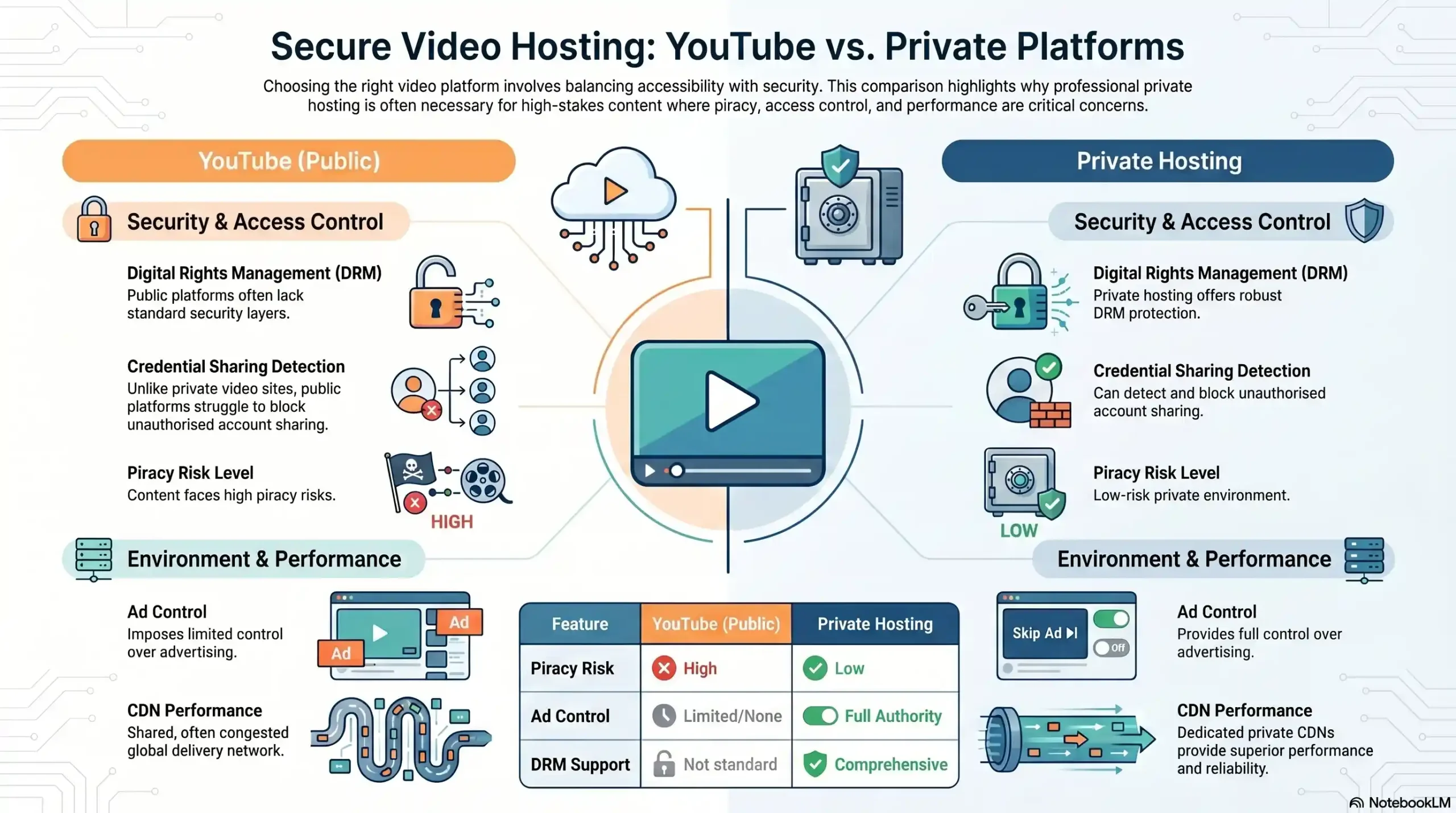
DRM Encryption
- YouTube: ❌ None
- Private Video Hosting (e.g., Inkrypt Videos): ✅ AES-256 / Widevine
Ad-Free Playback
- YouTube: ❌ Ads by default
- Private Video Hosting (e.g., Inkrypt Videos): ✅ Fully ad-free
Access Control
- YouTube: ❌ Basic/None
- Private Video Hosting (e.g., Inkrypt Videos): ✅ Token-based, domain-locked
Dynamic Watermarking
- YouTube: ❌ Not available
- Private Video Hosting (e.g., Inkrypt Videos): ✅ Forensic-grade
Credential Sharing Detection
- YouTube: ❌ Not available
- Private Video Hosting (e.g., Inkrypt Videos): ✅ Real-time alerts
Global CDN Performance
- YouTube: ⚠️ Limited control
- Private Video Hosting (e.g., Inkrypt Videos): ✅ Amazon CDN integration
Analytics & Engagement Data
- YouTube: ⚠️ Basic
- Private Video Hosting (e.g., Inkrypt Videos): ✅ Detailed per-viewer insights
Piracy Risk Level
- YouTube: 🔴 High
- Private Video Hosting (e.g., Inkrypt Videos): 🟢 Low
What to Look for in a Private Video Hosting Platform
Before evaluating any platform, serious content businesses need a non-negotiable checklist. The market is full of tools that use the word “secure” as a marketing term without ever specifying what encryption standard they use, what happens when a breach occurs, or how they handle forensic tracking.
The 5 Non-Negotiables for Secure Video Hosting
1. DRM Encryption (Widevine / AES-256) Digital Rights Management is the legal and technical backbone of content protection. Widevine — the same standard used by Netflix and Google Play — prevents content from being downloaded, screen-recorded at the hardware level, or redistributed without authorization. AES-256 encryption ensures data is unreadable in transit. Any platform not offering one or both of these standards is not truly secure.
2. Dynamic Watermarking Static watermarks are easily cropped. Dynamic watermarks are invisible to the viewer but embed unique session data — user ID, IP address, timestamp — directly into the video stream. If leaked content is ever discovered online, the source can be traced back to the exact user within minutes.
3. Global CDN Performance Security means nothing if the video buffers for 30 seconds before playing. A content delivery network distributes your video across global server nodes, ensuring fast load times for viewers in New York, Lagos, Singapore, and São Paulo equally. Amazon CDN infrastructure — the gold standard for enterprise delivery — is the benchmark.
4. Anti-Piracy & Access Controls Domain locking, IP restrictions, geo-blocking, token-based authentication, and simultaneous login limits are the access control layer that determines who can watch, from where, and on how many devices at once.
5. Easy Integration (No Dev Team Required) Enterprise-grade security should not require an enterprise-sized IT department. The best platforms offer WordPress plugins, simple embed codes, and clean APIs that allow a solo creator to go live in 30 minutes — not 30 days.
Red Flags to Avoid in a Video Hosting Provider
- Vague “bank-grade security” claims with no named encryption standard
- No forensic watermarking or session tracking
- Limited device compatibility that excludes older browsers or mobile devices
- No mention of CDN infrastructure or global delivery architecture
- Support limited to ticket systems with 48-hour response windows
The Best Private Video Hosting Platforms in 2026
1. Inkrypt Videos — Best for DRM Security + Global Delivery
For content creators and businesses where piracy is not a hypothetical risk but an active revenue threat, Inkrypt Videos is the definitive answer. Built from the ground up as a security-first platform, Inkrypt combines Widevine DRM encryption, dynamic forensic watermarking, and Amazon CDN-powered global delivery into a single solution that takes under 30 minutes to integrate.
Unlike enterprise competitors that bury security features behind complex onboarding processes, Inkrypt’s WordPress plugin and clean API make military-grade protection accessible to a solo course creator and a 500-person media company alike. Real-time analytics provide per-viewer engagement data, while anti-piracy controls — including domain locking, IP restrictions, and credential-sharing detection — ensure that every view is an authorized view.
Universal device compatibility, including support for older browsers and devices that competing platforms frequently abandon, means your global audience never encounters a playback wall.
Key Features: DRM Encrypted Streaming · Dynamic Watermarking · Amazon CDN · WordPress Plugin · Anti-Piracy Suite · Real-Time Analytics · Universal Device Support · 30-Minute Setup
🚀 Protect Your Content with Inkrypt Videos — Get Started Today
Stop leaving your premium video content unprotected. Inkrypt Videos delivers the DRM encryption, dynamic watermarking, and global CDN performance that serious creators demand.
👉 Visit inkryptvideos.com
2. Vimeo OTT — Best for Creative Professionals
Vimeo OTT (now part of Vimeo’s broader platform) is a strong choice for filmmakers, creative agencies, and independent publishers who prioritize aesthetics alongside monetization. It offers subscription and pay-per-view models, a clean player interface, and basic access controls. However, its DRM capabilities are limited compared to dedicated security-first platforms, and dynamic watermarking is absent — making it a better fit for brand-conscious creators than piracy-concerned ones.
Best for: Independent filmmakers, creative studios, boutique streaming channels Security Level: ⚠️ Moderate — basic access controls, limited DRM depth
3. Wistia — Best for Marketing & Lead Generation
Wistia carved its niche in the B2B marketing world by turning video into a lead generation engine. Its heatmaps, viewer engagement graphs, and email capture integrations are best-in-class for marketing teams. Security, however, is not its core value proposition — it offers domain restrictions and basic privacy settings but lacks enterprise-grade DRM or forensic watermarking. Ideal for product demos and marketing content, not for protecting premium course libraries.
Best for: SaaS companies, marketing teams, product demos Security Level: ⚠️ Basic — marketing-focused, not security-first
4. Uscreen — Best for Membership & Subscription Models
Uscreen is purpose-built for creators who want to launch a Netflix-style subscription service around their video content. It handles monetization, membership management, and branded apps exceptionally well. Its content protection relies primarily on access control rather than true DRM encryption, which leaves gaps for determined bad actors. A solid choice for building a subscription community, but not the frontline defense against sophisticated piracy.
Best for: Fitness instructors, online communities, subscription video-on-demand Security Level: ⚠️ Moderate — strong access control, limited DRM
5. Dacast — Best for Live Streaming & Broadcast
Dacast is a broadcaster’s platform, optimized for live streaming with low latency and reliable uptime. It supports HLS encryption and offers paywall features for live events. For organizations that need to monetize live broadcasts — sports events, conferences, religious services — Dacast delivers well. Its on-demand security features are functional but not as deep as dedicated DRM platforms.
Best for: Live events, broadcasters, sports organizations Security Level: ✅ Good for live — moderate for on-demand
6. Brightcove — Best for Large Enterprise Teams
Brightcove is the enterprise heavyweight, trusted by major media companies and global brands for large-scale video operations. It offers robust DRM options, multi-CDN delivery, and deep analytics. The trade-off is complexity and cost — Brightcove requires significant technical resources to deploy and maintain, and its pricing places it well outside the reach of small to mid-sized content businesses. If you have a dedicated video engineering team, it is a formidable option.
Best for: Global media companies, large broadcasters, enterprise IT-backed teams Security Level: ✅ High — enterprise DRM, high cost and complexity
7. Panopto — Best for Corporate Training & Education
Panopto is specifically designed for internal corporate training and academic institutions. It integrates deeply with LMS platforms like Moodle and Canvas, making it the natural choice for universities and L&D departments. Its security model is built around internal network access controls rather than consumer-facing DRM, which means it is not designed for public-facing course sales or external content monetization.
Best for: Universities, corporate L&D teams, internal training libraries Security Level: ✅ Good for internal — not designed for external commercial use
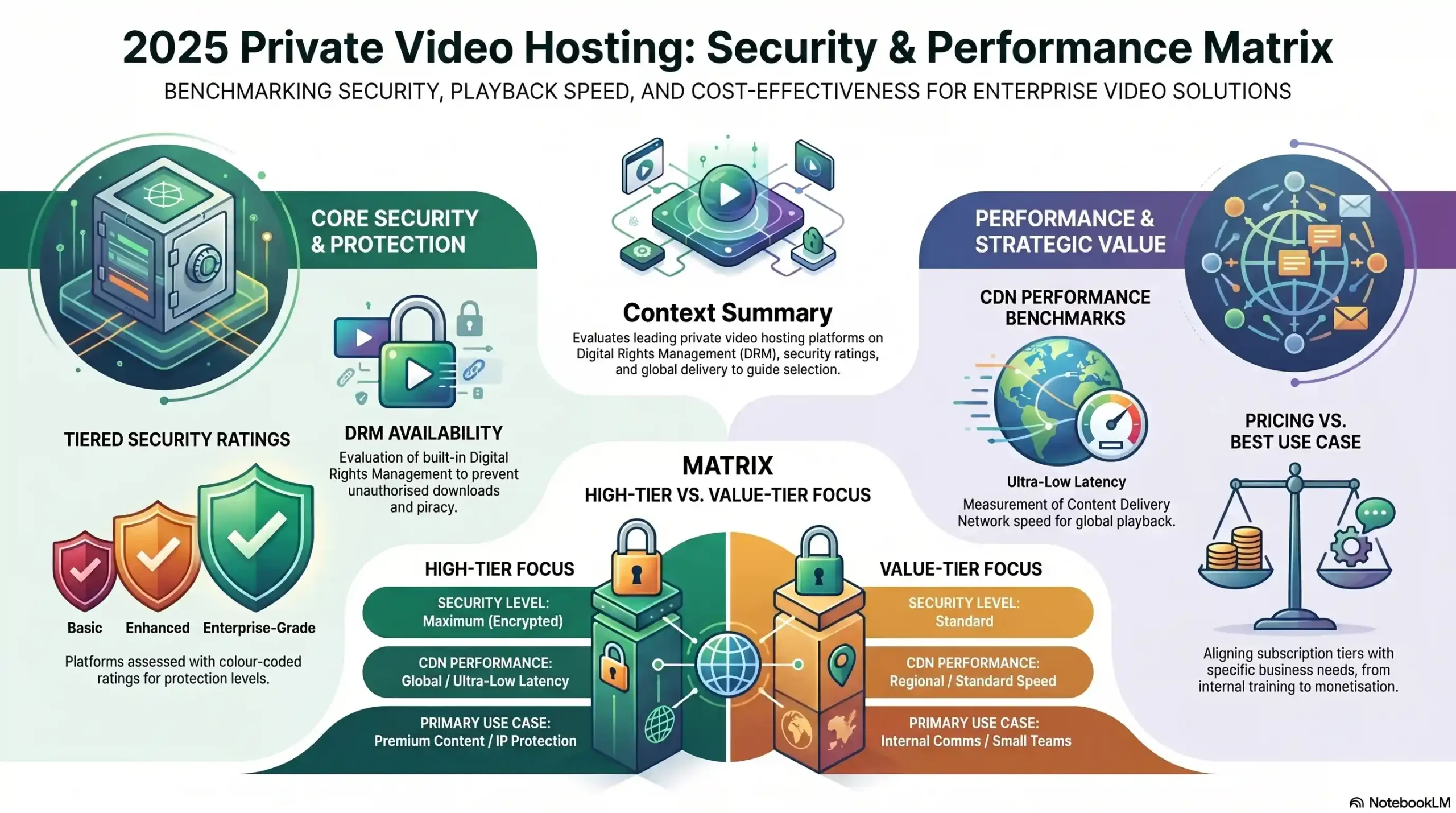
Inkrypt Videos
- DRM encryption: ✅ Widevine + AES-256
- Watermarking: ✅ Dynamic Forensic
- Global CDN: ✅ Amazon CDN
- Best for: Creators, Enterprise, Publishers
- Security level: 🟢 Highest
Vimeo OTT
- DRM encryption: ⚠️ Limited
- Watermarking: ❌ None
- Global CDN: ✅ Good
- Best for: Creative professionals
- Security level: 🟡 Moderate
Wistia
- DRM encryption: ❌ None
- Watermarking: ❌ None
- Global CDN: ✅ Good
- Best for: Marketing teams
- Security level: 🟡 Basic
Uscreen
- DRM encryption: ⚠️ Limited
- Watermarking: ❌ None
- Global CDN: ✅ Good
- Best for: Subscription creators
- Security level: 🟡 Moderate
Dacast
- DRM encryption: ⚠️ HLS only
- Watermarking: ❌ None
- Global CDN: ✅ Good
- Best for: Live streaming
- Security level: 🟡 Moderate
Brightcove
- DRM encryption: ✅ Enterprise DRM
- Watermarking: ⚠️ Limited
- Global CDN: ✅ Multi-CDN
- Best for: Large enterprise
- Security level: 🟢 High
Panopto
- DRM encryption: ⚠️ Internal only
- Watermarking: ❌ None
- Global CDN: ⚠️ Limited
- Best for: Corporate training
- Security level: 🟡 Internal use
Why DRM Encryption Is the Gold Standard for Video Protection
Not all security is created equal. Password protection stops casual sharing. DRM encryption stops determined pirates — and that distinction is worth millions in protected revenue for serious content businesses.
How Widevine & AES-256 Encryption Actually Work
AES-256 (Advanced Encryption Standard, 256-bit) encrypts the video file itself during transmission. It is the same standard used by governments and financial institutions worldwide, and it ensures that even if a data packet is intercepted, it is computationally impossible to decrypt without the authorized key.
Widevine DRM operates at the hardware level. When a viewer presses play, Widevine verifies their authorization, decrypts the stream in real time within a secure environment, and actively prevents the operating system — and therefore any screen-recording software — from capturing the decrypted frames. This is why you cannot screen-record Netflix. Inkrypt Videos uses this same technology to protect your content.
Together, these two standards form a protection layer that no freely available piracy tool can currently bypass.
Dynamic Watermarking — Your Last Line of Defense Against Piracy
Even with DRM in place, sophisticated actors sometimes find workarounds — pointing a physical camera at a screen, for instance. This is where dynamic watermarking becomes the final accountability layer.
Unlike static logo watermarks, dynamic watermarks are invisible during playback. They encode unique session data — the viewer’s user ID, IP address, login timestamp, and device fingerprint — directly into the video stream at the pixel level. If a pirated copy of your content appears online, Inkrypt’s forensic system can analyze the watermark and identify the exact account responsible within minutes.
This transforms piracy from an anonymous crime into a traceable, actionable event.
Inkrypt Videos — A Deeper Look at the Secure Platform Built for Creators
Inkrypt Videos was founded on a single, uncompromising premise: that content creators deserve the same level of protection that Hollywood studios pay millions of dollars to achieve — without the Hollywood-sized budget or IT department.
The platform delivers on that promise across five core pillars:
Uncompromising Security — Widevine DRM, AES-256 encryption, and dynamic forensic watermarking work simultaneously to protect every stream at every layer.
Global Performance — Amazon CDN integration ensures that a student in Dubai, a subscriber in Berlin, and an enterprise viewer in Tokyo all experience the same buffer-free, high-definition playback.
Easy Integration — A dedicated WordPress plugin, clean API documentation, and pre-built embed codes mean that most customers are fully operational within 30 minutes of signing up — no developer required.
Universal Compatibility — Inkrypt’s player works across all modern browsers, mobile operating systems, and critically, older devices that competing platforms frequently abandon.
Complete Transparency — Real-time analytics deliver per-viewer engagement data, watch-time heatmaps, and security event logs so you always know exactly who is watching, for how long, and whether any suspicious activity has been detected.
📞 Talk to the Inkrypt Videos Team Today
Whether you are a solo course creator or managing an enterprise media library, the Inkrypt team will configure the right protection plan for your content in under 30 minutes.
🌐 Visit inkryptvideos.com